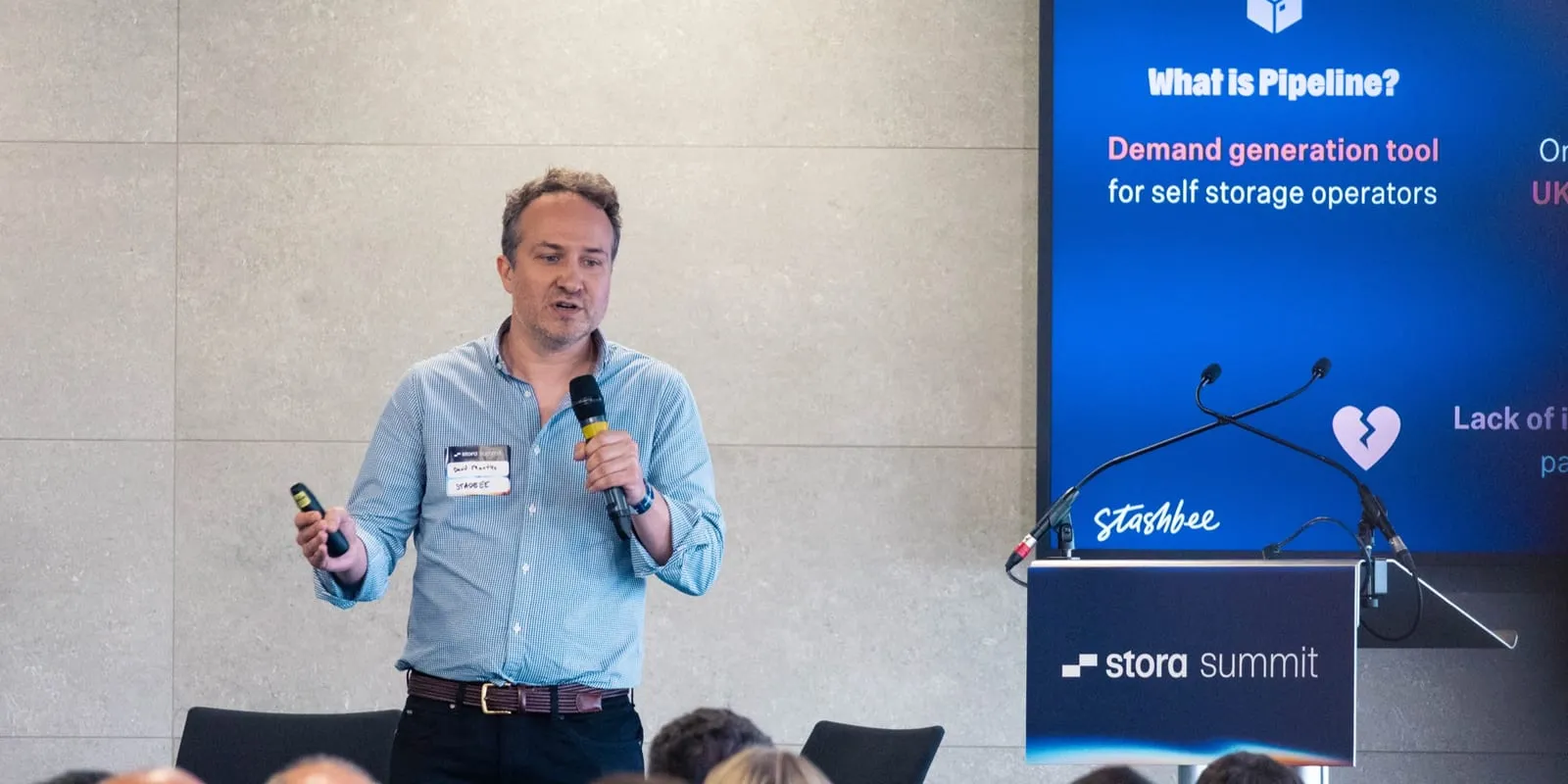




Once a site fills up, price is the main lever left for growing revenue. It has three parts: base rates, dynamic pricing and existing customer rate increases (ECRIs). For the latest FEDESSA Self Storage Sessions webinar, we asked a valuer and two operators how they manage each one.
The webinar ran on 20 October 2026.
The panel:
- Gavin Shields, CEO and co-founder of Stora, who hosted
- Ollie Saunders, Head of Self Storage at Savills, who values, sells and finances self storage across Europe
- Finn-Kristof Kausch, Managing Director of Space4You, which runs and manages self storage sites in Germany and Switzerland
- Matthieu Burnand, founder of Bien Sûr, which has three facilities and about 1,500 units around Paris
You can watch the full recording above. Below is a breakdown of what they discussed, followed by the full transcript.
Key takeaways
- Base rates, dynamic pricing and rate increases work as one system.
- Price on what customers will pay, not on cost plus margin.
- At Bien Sûr, only 1 in 30 to 40 customers act on a 5 to 10% increase.
- In Stora data, increases of up to 15% didn’t noticeably raise churn.
- New to increases? Test on a handful of customers first.
How the three pricing levers fit together
Each lever does a different job, but they only work well together.
Here’s how the panel defined them:
- Base rate: your standard price for a unit type, say €100.
- Dynamic pricing: a premium on the base rate when you have few units left, or a discount when you want to sell more.
- Street rate: the result, and the price on your website today.
- ECRI: the increase an existing customer gets, usually after 6 or 12 months.
From a valuer’s point of view, what matters is the result. Is average rent improving while occupancy stays stable? That is what investors and lenders look at. ECRIs now come up much more in conversations with investors, because they show how sticky customers are.
What underpricing looks like
Ollie gave two examples of value left on the table:
- The whiteboard waiting list. One owner in Scotland kept his waiting list on a whiteboard and never put rents up, because the customers were his mates.
- The 97% site. Another client tested higher prices over 6 months and moved rents by 30 to 50%. Occupancy only fell to 94%. In Ollie’s view, they could have pushed further and let occupancy drop to 85% with new customers paying more.
He also warned against trusting pricing software blindly. Computers can discount too heavily or get churn wrong, so keep some human judgement in the loop.
Where operators leave the most money on the table
Ollie named two common mistakes:
- Discounting too hard to fill. Heavy early discounts are fine if you know where you will stabilise, but they make yield management harder later. One client filling at €10 per square metre switched to €15, and the fill rate did not change.
- Being timid with increases. As Ollie put it: “If nobody challenges you on your price rise, have you got it right?”
How customers react to a rate increase
This is the fear that stops most operators. The panel’s experience is that the reality is much calmer:
- Bien Sûr: about 1 in 10 customers get in touch after a 5 to 10% increase. Most ask why or try to negotiate, and accept a plausible reason. Only around 1 in 30 to 40 take any concrete action.
- Space4You: when a customer pushes back, the store manager says they will check with the manager, calls back 5 minutes later and halves the increase. That happens with about 1 in 40 to 50 increases, and everyone ends up happy.
- Stora: operators have run tens of thousands of rate increases since launch. Increases of up to 15% have shown no noticeable difference in churn 6 months later. Gavin was clear that this doesn’t mean every operator can push that far.
Most Stora customers haven’t turned automated rate increases on yet. Those who have saw revenue grow by 10% on average in their first month.
On messaging, Finn’s advice was to keep it short. He used to explain every increase in detail. Now he keeps the message clean and simple, and most customers understand.
How often, and how much
Here’s how each panellist approaches it:
- Finn: Space4You looks at each customer before raising their price. The first increase comes after the introductory discount ends, then roughly every 9 months. They do not normally do double-digit increases, because German customers are price sensitive.
- Ollie: ECRIs across self storage can be over 10% a year in the current climate, and churn does not necessarily rise when operators go slightly higher. Self storage is a needs-based product, not a gym membership.
- Matthieu: Bien Sûr adjusts by unit size. Small units take a higher percentage (10% on €40 is only €4), except the very smallest, where customers move most easily. Large units get a smaller percentage.
Sometimes operators even want higher churn. If the market has moved, a customer paying £100 can be taken to £150, because the unit would re-let at £160.
New to increases? Ollie’s advice is to test on 6 customers first.
Setting base rates on a new site
Matthieu’s first rule: price on willingness to pay, not on cost plus margin.
To estimate it:
- Start with competitors. Most publish prices online. Phone the ones that do not.
- Adjust for distance. One Bien Sûr site with no competitor within a 10-minute drive has much more pricing power than another directly across the street from two competitors.
- Adjust for local incomes.
Once open, he prices for the move-in rate he needs. When filling, Bien Sûr aimed for about 30 move-ins a month. Its first facility is now over 90% full and only needs 15, so prices go up until conversions roughly halve.
Keeping base rates on track
- Street rates are not what operators achieve. If competitors list £20 to £30 per square foot, what they actually collect over a year with seasonality and discounts can be very different. Savills runs a “Rent Doctor” comparison for this. Because the industry shares so little data, Ollie encouraged operators to swap numbers with peers.
- Review base rates regularly. Gavin shared a habit from Adrian Lee, former Operations Director at Big Yellow: raise base rates by inflation every year by default, so they never fall behind by accident. Finn reviews monthly instead, using an AI agent that monitors competitor prices and recommends changes.
Introductory offers
Matthieu shared that introductory offers mainly work because people underestimate how long they will stay. Bien Sûr customers who say they will stay 3 months stay about 7 on average.
The downsides:
- Gaming the offer. Some customers rebook under a different name to get the discount again.
- Longer-term customers lose out. The offer slightly penalises people who were always going to stay.
- Discounts must be unwound. Filling a new store quickly helps you sleep at night. But if a 50% discount means you need a 50% increase to catch up, that is hard to put through.
Pricing in a tougher economy
The panel agreed self storage holds up well in a downturn, though it still feels the effects:
- France: Matthieu expects passing increases on to be harder over the next 5 years, and doesn’t think the 30% increases seen in the US would work there. He also pointed to US data from 2008 and 2009, when revenue fell by about 6 to 7% as both rate and occupancy dropped.
- UK: Ollie pointed to local factors. In Swindon, disposable incomes fell when Honda left, and operators struggled to push rents. Demand drivers also shift in a downturn: people starting online businesses, or adult children moving back home with their belongings.
- Germany: Finn sees the housing crisis creating demand for storage, but Space4You stays careful with increases and avoids double digits.
Questions from operators
Should a bigger unit ever be cheaper than a smaller one? Finn was relaxed about it. Hotels on Booking.com sometimes price a larger room below a smaller one. It steers customers to what you need to sell, and the goal is to fill every unit type.
Is there merit in pricing above your competitors? For Ollie, yes, if you have the courage of your convictions and a better product. A dry, warm, clean building is worth more, the same way he paid £50 more to fly British Airways rather than easyJet. For Matthieu, it depends on the stage. While filling, competitor prices matter. Above 90% occupancy, your own unit-type occupancy is what should guide price.
What is a healthy fill rate for a new site? Ollie’s honest answer: it depends. A 50,000 square foot store can take four years to fill. He separates physical stabilisation (reaching about 85% occupancy) from economic stabilisation (when all discounts are unwound and rents are right). Gavin added Adrian Lee’s rule of thumb: plan to fill over two or three summers. Matthieu noted that location changes everything. A site in central Paris will fill far faster than one in rural France.
Should access data feed into rate increases? Finn’s new access system shows how often each customer visits, and Space4You is considering higher increases for the heaviest users. Gavin pointed out the counter-argument: frequent visitors may also be closer to moving out.
One thing to change next month
- Finn: do not wait to increase prices, and use data. Also look beyond the street rate: Space4You charges €2.50 to €3 a month for 24/7 access as an add-on.
- Matthieu: if you have never done a rate increase, try one. It is far less scary than it seems.
- Ollie: talk to your peers and swap data, and build a strong sales culture.
- Gavin: do something. There is a lot of revenue to gain from managing price, without adding units or opening new sites.
Chapters
- 0:00 Introductions
- 2:33 How base rates, dynamic pricing and rate increases fit together
- 12:11 Where operators leave the most money on the table
- 13:37 Existing customer rate increases: how often and how much
- 18:54 How customers react to a price increase
- 21:54 How far can you push before customers leave?
- 26:16 Setting base rates on a new site
- 31:25 Dynamic pricing: what self storage can learn from airlines
- 33:19 Introductory offers
- 36:51 Pricing in a tougher economy
- 43:59 Q&A: should a bigger unit ever be cheaper than a smaller one?
- 45:11 Q&A: pricing above your competitors
- 47:43 Q&A: what’s a healthy fill rate for a new site?
- 50:59 Should access data feed into rate increases?
- 55:11 One thing to change next month
Read the full transcript
This transcript is auto-generated, so it may contain errors.
Gavin Shields: Thanks everyone for joining. I'm really looking forward to this. I find the management and optimisation of pricing a really interesting topic in self storage. And hopefully we can cover a lot of topics here and provide some useful insights. So before we get started, I thought some quick introductions from myself and Finn, Matthieu and Ollie. My name is Gavin Shields. I'm the CEO at Stora, which is a software platform for self storage operators used by around 12% of the European self storage market. I also have a self storage site here in Northern Ireland as well. So I know a little bit, but that's a very small site.
Excuse me, sorry, I'm just getting some pop-ups. So that's a small site and so I don't profess to be the experts. Luckily, we are joined by a couple of real experts here as well. So maybe before we get into Finn and Matthieu, Ollie, can you introduce yourself, please?
Ollie Saunders: Hi, Gavin. Thanks. And great to be here. Yes. So I'm Ollie Saunders and I'm head of self storage at Savills. We work across Europe from Spain to Sweden, Italy to Ireland, advising operators and owners of self storage assets. We're a team of nine and we cover valuation data and research and agency in terms of acquiring and disposing of self storage properties and have been working in the sector for about 25 years now.
Gavin Shields: Thank you, Ollie. We'll go over to Germany. Finn, can you introduce yourself, please?
Finn-Kristof Kausch: Good afternoon, everyone. Thank you very much. My name is Finn. I'm a small operator from Germany. So we're operating four sites in the DACH region and starting now into third-party management for the DACH region. And yeah, very looking forward to that seminar. Thank you.
Gavin Shields: Thank you, Finn, Matthieu.
Matthieu Burnand: Hi, everyone. So I'm, yes, Matt. So I'm the founder of Bien Sûr. So we have three self storage facilities in the Paris area in France. So for about a total of 1,500 units. So yeah, happy to share what I've learned so far in my three years at Bien Sûr.
Gavin Shields: Great. Well, thanks very much. It's just great to have a really good spread across Europe so we can cover different stories in different countries, because that's really relevant here. I'm going to start with Ollie. So, Ollie, you bring 30 years of experience in the industry, valuing, selling, and financing self storage. From where you sit, we're going to talk about three things here today. We're going to talk about base rates, dynamic pricing, and ECRI, existing customer rent increases or rate increases. From where you sit, how do these three things affect each other? And you might want to start with maybe, just before we start the call, just defining a couple of those things as well for the audience.
Ollie Saunders: Yeah, sure. Yeah, so, yeah, there's a lot of jargon and terminology in self storage, isn't there? And I think it's helpful for us all to understand what we're talking about. So, an ECRI is an existing customer rate increase. So, when the customer's been out for six or 12 months, you might give them a 10 or 15 or 3% price rise. I think we often have, you know, we have street rates, which is the rate that is available on your website. And I think the phrase that's being used is sort of the base rate. And that's your standard rate. So, it might be, say, €100. But you would apply a premium to it if you've got fewer units, and a discount if you want to sell more units to that.
So, your street rate is your base rate, plus or minus its premium, or discount on that basis. And, you know, all these things are completely, you know, interlinked as well. But, I mean, from our position as somebody who looks at the financial performance of self storage, we're not interested. Well, we are interested in how. We need to understand it. But what we're interested in is what actually you are achieving and how you're using it to effectively bring a stable store with good performance in terms of its rental growth. And that's what attracts investment into self storage. And it's long been thought that storage has this link to CPI, inflation, and so on.
So, that's important for a stable store. And I think increasingly, we're seeing that ECRIs are much more at the forefront of conversations with investors, because what they're interested in is actually how sticky is a customer and what's the pricing elasticity. And the data and tech and analysis is much more available there. So in certain markets, you know, one client says, well, if you put the rents up 10%, they get the same churn as having a 25% churn rate. Sorry, I'm in an airport, which is very embarrassing. So...
Gavin Shields: It's fine, we can hear you well.
Ollie Saunders: You can hear me well, can you? Okay. So, and we can see different levels of sophistication, and every operator has a different strategy. There are as many strategies as there are operators. And when we see some classic examples: we sold a property in Scotland, and the client who was selling had a waiting list on his whiteboard in his office. So I mean, that's just got everything wrong with it, hasn't it? That actually you have a waiting list, and my god, it's on a whiteboard. And he didn't put up the rents because they're all his mates, and he quite liked turning up and doing that. So you could see, you know, that there was quite a lot of value left on the table there as well.
But what we want to see when we appraise self storage buildings is that the space can be absorbed in the local market, so there's not too much supply, that there's enough demand that comes into it. And, you know, what we don't necessarily like to see is operators who are suddenly really heavily discounting, because that gives an indication that the market is really, really, really competitive. And I've never been convinced that selling space at less than what your current customers pay, to try and kick out some of those existing customers, is a sensible place to be.
But what interests us is also the elasticity. So how much can a customer accommodate in terms of that increase as well, and if you push it too far, do all your customers move out? And that elasticity varies across Europe. It varies across towns as well, based on the client base that is there.
And I think one thing also that is important is to understand the providers that sell as a commoditised product, or actually if the business is selling on other things other than price. So we can see that businesses with good culture tend to outperform. And that's a big sweeping generalisation, but motivated sales teams selling really good real estate assets in the right location do outperform others who take a more sort of automated approach to self storage. But, you know, you guys who operate self storage know more about it than me. It's about generating inquiries and then converting them, and thinking about how you want to use price in terms of those conversions as well.
And, you know, another good example is a client of ours had a facility that had 97% occupancy. They'd been building out a platform. The rents made sense because it made the development viable. And over a period of six months they did some testing, and they actually were able to move the rents by 30, 40, 50%, and they took occupancy from 97 down to 94. And I use this as an illustrative case because actually maybe we should have doubled the rents. Because what we didn't want is the occupancy to go from 97 to 94. We perhaps wanted it to go to 85, and to charge those new customers coming in more money.
And also, I'm sure we're going to talk about the economy and how tough it is out there across Europe, and it's going to get tougher, and customers are going to be more price sensitive. But it's interesting seeing how operators look at ancillary income in a different way. So for instance, we're beginning to see some operators charge for digital locks. So they may be charging four or five or six euros a month for the customer to be able to access their unit on their phone. And also, you know, smart pricing, and things like customer protection or insurance, or offering sort of gold, silver and bronze pricing.
But what we love to see in this market, and it's one of the many reasons I love self storage, and I'm a self storage geek, is that it's actually full of entrepreneurs who like to try things. And it's that testing and getting the data and understanding what your customer is prepared to pay. And I think one thing that we may want to also touch on is: don't always believe what the computer tells you to do in terms of that pricing. You do need to stand back and have some of that human judgement there, because sometimes the computers don't get it right, and they discount too heavily, or their churn rates go wrong as well. And I think knowing your customer in the market that you're in is really important.
So, you know, to answer the question, there are so many different strategies, but you should always look at the results at the end of every month. And actually, you know, is your average rent improving? Is your occupancy staying stable? You know, is this a resilient cash flow that self storage can generate? And if it's jumping around all over the place, then you probably need to look quite hard at it.
Gavin Shields: One of the things, Ollie, that you shared at the Nordic association summit, and then again at the Stora Summit as well in June, was this great chart which showed occupancy filling up for the first couple of years at a facility, and then, you know, the revenue line coming in along with it. And then occupancy levelling off at some point, whether it's 85, 90, 70, whatever it might be. But then, you know, the revenue beyond that: how do you continue to grow that? And for me, it really made me think, well, sometimes it's just about recognising that that's one way to think about your self storage business. Beyond the fill-up stage, what are you going to do once you've hit that occupancy to keep going? And like you said, there's not necessarily a right answer, but there are these three things, I think, to think about: you know, the street price or base rate, dynamic pricing, what you're doing to that price over time, and then the rent increases. And it's really interesting. One thing that I was wondering, from your point there, which is not really about pricing, actually.
It's just you said something interesting about the type of facility, almost like the quality facilities can sustain better, maybe stronger revenue over time. You touched very briefly on some of the traits there. What do you see as the traits there that give an operator the ability to kind of, I suppose, retain that over time? Because it's something that I've seen even in my own sites. One of them was a bit more run down, and it was trickier to kind of put things through, whereas the other site is a brand new site, and I felt a lot more confident about changing the pricing. But I don't have the data to back it up.
I'd be interested to hear a bit more about what you meant there.
Ollie Saunders: Yeah, I mean, there's lots of data out there. And actually, at the end of the day, I'd rather have a second-generation self storage facility on a really good location because that tends to do quite well. But, of course, what I'd really like is a really good modern self storage facility. And at Savills, as we talk about the next generation of assets, so those that are digitally enabled, that are really easy to use, that's a great customer journey, that's got great staff, that feels dry, safe, secure, because you're always going to out-position. And in markets where we're seeing more supply coming on board, you want to give your sales team the best possible product to sell.
And I think that is noted. And in a downturn, you're going to be really grateful that you've got the best kit on the street, because there's always going to be choices in there at the end of the day. So I'm a real estate guy, but great real estate attracts the right money and the right lenders. And I think also we need to be very careful. The industry is now 30 years old, and some of these buildings are going to start to become obsolete. They're actually not going to be fit for purpose. They're going to be struggling to compete with some of the new kit that's coming out and new products like Drive Up and Urban and the improvements that we're seeing in other products being delivered as well.
So it's a bit like your house. You want to have the best house on the street if you want to sell it in a recession, don't you?
Gavin Shields: Yeah. Excellent. OK, thank you, Ollie. Before we move on, is there one area where you see across Europe operators tend to leave the most money on the table?
Ollie Saunders: That's a really, really difficult question. I think filling quickly when you have a new store at discounted rents is fine. I think that's what we're really worried about is where will you stabilize at if you take three or four years and we know you're going to be at 25 euros a square meter. That's fine. If you're filling at 15 euros, that's fine. What we often do find is people discount really heavily in the early days and then that yield management gets even harder. And we had a client who was filling at something like 10 euros and they just took the switch to 15 euros and the fill rate didn't change.
So, you know, think about the price sensitivity of those customers as well. And also, I think people who take a blanket approach or can be quite timid in their pricing. Now, I don't think you should be aggressive, but if nobody challenges you on your price rise and you put through 100, then have you got it right as well? But I do think we need to be careful as a sector and not overly aggressive and stuff's happening in the States to reflect operators who are discounting really heavily and who are then charging, you know, who are pushing quite high. But, yeah, I'm just a real estate guy that looks at what you've achieved, not how you achieve it.
But everyone's got different views, which is why it's such a good conversation.
Gavin Shields: Well, let's flick then to how do you achieve it with Finn and Matt who are on the ground doing that. Finn, I'll ask you first, when does it make sense to move your prices up and down with occupancy? And when does it not make sense for you?
Finn-Kristof Kausch: So, first of all, in Germany, on the DACH region, we have the biggest problem is actually that the latest figures are that 52% of our customers have no idea. I have never heard about self storage. So that means they don't have really a feeling about what is the right cost of self storage and what it is worth. So this is hard. But on the other hand, how we set up basically the base fee or the street rate, we are working now with AI agent, which is basically screening all our competitors and give us a recommendation. But on the other hand, we have a look at every single customer before we raise that price.
And we basically make it after a few months. So the first month will be after the first discount month and then we normally go every nine months up.
Gavin Shields: Okay, so Finn, you're reviewing prices after a few months and then doing something every nine months or so. Okay. And so this is on your existing customer rent increases. This is the customer who's in there, how you're managing their price. So a bit like myself, my Sky bill or my mobile phone bill. Every year it goes up a little bit. I get an email, up it goes. That's what happens. So it's that sort of approach. Sorry, Matt, what about yourself? How do you see that working for existing customers? How do you handle those existing, those increases for existing customers? We have gone a little bit, we've sort of stepped, we've gone out of order a little bit here on the questions.
So I'm talking about, we planned, talking about existing customer rent increases. How do you handle those for existing customers? How often? How much?
Matthieu Burnand: Yeah, that's a good question. Well, I think the first thing in deciding how to, well, doing ECRIs, I think is also getting the right data, because it's, it's one thing to have a strategy, but I think you really need to collect data on, you know, on, on, on, on, on, again, what, what, what's best? Is it better to do multiple small increases, or, or a few big increases? what's best? And I think that's a question at least that I've asked myself a lot. And I still don't truly have the data for that. And that's actually something that I'm trying out now. And so, yeah, being able to collect that data and act on that data for me is the most important part.
And then, yeah, and then I guess, you know, I mean, then, you know, what do you base those increases on? Well, obviously, you look at what your competition is doing. You look at your occupancy rates. So some units will fill up better. And so it's true that we actually have some units that sometimes, you know, sell out, even though where it may be only 50% occupancy, that's clearly a sign that that unit needs to be increased. And same, sometimes our units don't fill up. And so those need to be, I mean, you need to add some promotions or decrease the prices.
Gavin Shields: You're taking into account there, you're taking into account your occupancy rates on the different unit types. What else do you consider? I mean, do you think, do you look at, so you've also mentioned, you look at competitors. Are there any other things that you look at there, around maybe how they're paying, like the size of the units? And I've heard that some operators will maybe put up the bigger units a little bit less as a percentage in the small units. Do you take those sort of things into account or not yet?
Matthieu Burnand: Yeah, completely. I mean, I agree with you on the larger and smaller units. It's true that on small units, you can usually have maybe a slightly higher increase. Because again, in absolute numbers, right, if someone's paying 40 euros a month and you increase them by 10%, that's only four euros a month, they likely won't leave you for that. So if you're on bigger units, you might, let's say, increase absolute amount, but decrease the percentage amount. But then also another thing we've noticed is sometimes the very small units, you also don't want to increase them too much, because I feel that's where the people are most mobile.
So again, if you have a very small unit, it's much easier to find a friend or to find a solution for your items. Whereas if you have like a 10 or 15 square meter, which is about 100 or 150 square feet for our British friends, then actually, it's harder for people to find a solution. And obviously, I feel like it's a lot more sticky, because not only is it harder to find a solution, but it's also more effort to get your items out of storage. And again, you can't just do that with your car, you have to rent a van. So there's more stickiness there, I find, too.
yes, there's more stickiness there, I find, too.
Gavin Shields: Okay. And, Matt, in your experience, and I think this is from talking to lots of our customers, it's often the thing that people fear, and it's the reason people don't carry out price increases. It's what is the reaction from customers? What, in your experience, has been the reaction to do these things? Ollie touched on it as well a little bit, but, you know, how do you deal with that? How bad has it been? Or what's your experience of that?
Matthieu Burnand: Yeah, it's pretty scary because before you do an increase, you're kind of afraid that it's going to be pandemonium. But in reality, when you, I mean, I think on average, we actually do have some data here, but on average, only about one in 10 customers will actually reach out to you after an increase. So it's only one in 10. And even on some increases, it can be lower. So it's really very little. And out of those, most of them will just kind of maybe try to negotiate or ask why. And if you give them a reason that sounds plausible, most of them will just kind of accept it.
So, you know, in practice, I mean, from our data, maybe only one in one in 30, maybe one in 40 will actually, let's say, take a concrete action after your increase. This is assuming maybe, you know, five to 10 percent increases. Obviously, you know, if you increase it more, you'll probably get more and more returns. But so, I mean, I speak to a lot of operators who are just afraid to increase rates. But it's really a big mistake because most people are actually somewhat used to it. And actually, most of them just won't budge, won't do anything.
Gavin Shields: That's the thing that I think is always worth remembering as well is that operators costs, our costs are increasing every year as well. You know, like all of our costs of this stuff out, the cost, electricity costs, everything, all our suppliers, all the prices. going up. So it's a natural step, actually. But Matt, sorry, not Matt, Finn, sorry, Finn, what's your experience been in the same area in Germany? How have you found customer reaction to carrying out these sort of revenue optimisation changes?
Finn-Kristof Kausch: Yeah, absolutely. Thank you. I can, basically, it's almost the same, like with us. It's very little what, who is coming back, actually. And what we do, we always try, if someone is coming back, we always try to value our customer and say, okay, we really understand your situation. We know it's difficult. And all my store managers say, okay, we will take care about this issue. I will speak with our manager, but they don't speak with me. But they're calling them back five minutes after and say, okay, we spoke with you. We value you. We reduce the increase in half. And most of the time, they are very happy with that.
But in the end, it's just one of 40 or 50 price increases. And in the end, everyone is then happy and you get your price increases through.
Gavin Shields: Okay, thanks, Finn. Ollie, you mentioned that, and I completely agree, we're talking here about managing the existing customers' rent increases over time. And there are two other areas we're going to come to in a second around price. But on this particular issue, Ollie, you mentioned that it really is, it depends on where you're based, it depends on the customer, it depends on so much. But that aside, do you have any data, do you have any insight into at what point do customers start to leave? If you don't have it, is there anywhere that people can find this type of thing? Because I'm just thinking, if you're going to do this for the first time, do you start at 2%?
Do you start at six? Do you start at 50? Is there any data? Obviously not 50, I wouldn't recommend that, but where can people find out more? And do you have any insight into how far can you think about this?
Ollie Saunders: I think we see a number of different data points, and often we will see that the ECRI in a self storage business can be, in this climate, over 10%. So every customer is getting a 10% increase over that year. Some of those percentages are higher and some of those percentages are lower. But what's interesting is that when people go slightly higher, the churn rate doesn't necessarily change. And it goes back to the point that you really need this product. It's not like cancelling a gym membership or those sorts of things.
And also, I suppose there's a concern, isn't there, that when you put a price rise through, you wake up the sleepers: the people that have actually completely forgotten about their self storage. And then you write to them and they go, oh my god, what am I doing? So I think, you know, it's a powerful tool. And I think also sometimes people want higher churn. So people will use ECRI to reduce occupancy because the market's moved and they know that they can sell the new units at higher rates. And that goes back to the principles, doesn't it? We're not being aggressive saying, well, you are paying 100 quid, I want you to pay 150 quid. It's like, I'm going to take you to 150 quid because actually I can re-let this unit at 160, because the market's moving up. So that is a really important point as well. It's not us being predatory, it's just reflecting the price that is there. Similar to a hotel, you know, their prices move every day as well.
But I think we did some podcasts with Christel Friberg Land, and we talked about the timidity in pricing. And if you put your prices up 3% and nobody rings you, you've probably got it wrong, haven't you? But I do like testing. And if you've never done it before, you can try it on six customers to start with and see what happens. You don't have to try it on all your customers at the same time. So play with it, and be entrepreneurial, and think about pricing like every business should do.
Gavin Shields: Timidity is a great word, actually, that you've just said there. Because amongst our customer base, we have a price increase tool that you can kind of set up, and it does a lot of stuff for you. The majority of customers haven't turned it on yet, I suppose, in the timid bracket: just kind of a little bit concerned about doing this. And most of the customers using it are the bigger ones, so probably as a percentage of value, there's about a quarter of a million pounds a month now of the revenue that we see through our platform through price increases. So, you know, they're working, they're going through. But one other thing I was going to say: what we've seen in our data, because our customers have done tens of thousands of price increases now since we released this about a year ago. And so we have some data around the percentage and the impact it has then on churn.
And what we see so far is that up to 15%, no discernible difference on churn six months further down the line. But again, it's the caveat that it doesn't mean that everybody can do that. It just means that the customers who have, that's worked for them. And it could be for some of the reasons you just said.
Ollie Saunders: I think also there's timidity because people are happy with passing through a 5% price rise. And if you're the owner of a self storage property and you're happy at 5% and that's great and you don't have any hassle, then move on. What's there to see? And actually, what we're saying is maybe you could take that to 10% or 4% for other customers and play with it as well. And I think the tools are out there. I mean, we obviously mentioned AI pretty early on as well. But I think there's more, you know, you can make better judgments than gut feel, which was probably the way the industry worked, you know, some time ago, I think.
Gavin Shields: So we've talked earlier then about how to manage customers once they're in. There are two other areas then that Ollie, you touched on at the start, which is your base rate, which is the kind of price you're setting. And when I've spoken to Adrian Lee, the former CEO of Big Yellow, he sort of says, look, the way they thought about base rate was you sort of set it. Let's say you really want to get to £25 a square foot or whatever. You're going to set your price there, but you're going to, so that's kind of where you want to get to over time, but you're going to discount off that as you get there over time.
So the base rate is that kind of, our target is £25 a square foot for that unit type. So that's the base rate. And then there's the what you do on that price, so the dynamic pricing off it. So I just want to talk about, go from existing customer rent increases to base rates and how people think about base rates, which is the rate you're sort of setting on your units. Matt, how do you set your base rates across your site? So you have three sites, 1,500 units roughly, And it's all in the past four or five years you've built this. So this is obviously a problem you're coming up against and something you're working through.
How do you land on your rates for units on new sites?
Matthieu Burnand: Yep. So first of all, I think it's important to set your rates based on, let's say, willingness to pay as opposed to cost. That can be a mistake, but a lot of people do is they take their costs and add a margin. That's definitely not how you want to do it in self storage. You want to look at what's a willingness to pay. And the best way to try to find out, you know, when you open your facility for the first time, what the estimated base rate in your neighborhood is, is to just look at competitors. I mean, of course, they'll have prices online. And those who don't, you need to call them up and give their prices.
So I'd say that's the first thing we look at. And then depending on the location of each facility, we well then I guess we look at two other factors which are how close or how close are are the other facilities? And then also what is, let's say, we try to estimate what the average income is in the area. We have actually two facilities that are pretty close to each other, maybe about a 15-minute drive. But we have one that's really differentiated by location. So the closest facility is maybe a 10-minute drive away. And we can just see we have a lot more pricing power there than in the other facility that's actually right across the street from actually two competitors.
So, yeah. And I think then it comes back to kind of a technical term that Ollie was using of elasticity is what's supply and what's demand. And based on how quickly you fill up, if you need to fill up, let's say 30 units a month, That's what we try to do when we open up and we're going to bring our rates down. And then now our first facility, for example, we're now over 90% full. So now instead of 30 units a month we want to do, we want to do 15 a month. And so you increase the price till you roughly divide your conversion rate.
Gavin Shields: Using elasticity, supply and demand is a great way to explain that, Matt. And yeah, that's really a nice way to think about it is just as you don't need 30 more bookings. In fact, you can't take 30 bookings anymore. You don't need 15. How much? What is the willingness to pay another great term for 15 customers a month?
Ollie Saunders: So also, a very important point that people should think about is that street rate isn't what that operator is achieving. So when you're doing your appraisal for a self storage facility, and you go on to StorTrack or other websites and databases, and you say, well, they're charging 30 pounds a square foot, or 20 pounds a square foot, what that operator achieves long term may be very different to that. Because street rate is only what they're charging today, and you've got seasonality and all sorts of different factors. So, you know, we do something called Rent Doctor, which is like, we say, well actually, over the year you're achieving 25 euros, and we know that most operators are achieving between 27 and 28. You know, something's wrong with your pricing, or the other way around as well.
So, you know, self storage doesn't have much transparency of data. This is one of the problems of the sector, isn't it? You know, making sure that we all know how each other is doing. You know, it isn't that open. So you need to talk amongst your peers, and it's a very collaborative industry, about how you're doing, and share data just to make that sense check that you're not leaving money on the table. If you've got a mate who runs a self storage facility, talk to him, or her, and swap data to see how well you're doing. Because it's a very inward-looking business, isn't it? If you don't know how other people are doing, it's very hard to know whether you're outperforming.
Gavin Shields: It is the sort of industry where people are happy to help each other out too so it shouldn't be too hard to find some people who can help and share their experience. Finn, what's your experience of setting base rates in Germany? How do you think about that?
Finn-Kristof Kausch: Well, it's basically also the same. We have to get the feeling what we can charge. And then when we're getting full, I think the point of dynamic pricing is something which is very undervalued. I'm always compared a little bit with a company like Lufthansa. I think they have at the moment around 24 different booking classes and probably 68 or 90 different prices. And I see so many self storage sites, they always stick to the same price. It doesn't matter how the occupancy is. And I think we can learn from different industries a lot for self storage to automate that much more to get a better return in the end.
Gavin Shields: And do you review your base prices on any kind of regular basis? One of the things that Adrian Lee mentioned to me a few months ago that I just thought, I don't know why I didn't think of that, he said that they reviewed just their base price every year and just by default would put it up by inflation. Just so that even the base price doesn't kind of fall behind accidentally over time. Is that something you think about or have done before?
Finn-Kristof Kausch: Well, I think the target should be that we always over the inflation and I think with self storage, you're good to go with that. But yeah, we are looking not once a year, we're looking basically every month and compared also with our competitors together with the AI agent, what they just recommend us to do to put up the prices or not. And then we are running for, we're using basically just the dynamic price system.
Gavin Shields: And this is open for any of the three of you really. How do you think about introductory offers? It's normally quite a hot topic. Any experience with that? Anyone want to go first?
Matthieu Burnand: Yeah, I'll be happy to try on. Yeah, that's a tough one. But I mean, I think the main reason they work is, I was looking at data a few weeks ago, is a lot of people underestimate how long they're going to stay in storage. And so I think that's, well, at least for me, that's the main reason one would use an introductory offer is, let's say you're going to offer your first two months at minus 50%. I know we have a lot of customers who tell us, hey, I'm going to stay three months. So when they do the calculus in their head, when they do the maths, they think, hey, I'm going to stay three months.
And it's actually something like, okay, well, it's actually going to cost me two months. But in reality, I think we looked at the data. The average person who says they're going to stay three months stays on average seven months. So the introductory offer gets short-term people in, And actually, they're usually going to stay longer than expected. But then also I guess you've got to be cautious because also introductory offers can also create bad behavior. You can have people who can try to rebook under a different name to get the introductory offer multiple times. And also it slightly disincentivizes longer term tenants. I'd say it's, yeah, you've got to use it, try to use it wisely.
But I guess that's how I try to understand it.
Gavin Shields: Ollie, do you see much in that area around a strategy to think about? Because sometimes we talk to new customers opening up new sites and sometimes there's a natural desire to want to get full because I had it myself, you're nervous about is anybody going to move in here? And so you think, oh, 50% off for three months and you kind of go big on the discounts or low on the pricing. And I think that after six, 12 months, there might be a bit of regret. 6-12 months, there might be a bit of regret. And you did touch on that a little bit earlier. But how do you see, maybe as an industry as a whole, that kind of discounting dynamic at the moment?
Ollie Saunders: Yeah, I mean, when you open a store, it's quite nice to fill really quickly because you probably sleep better at night, don't you? It's sort of a reassurance that the demand is there. And you can say, look, I've got people coming at me wanting to store their stuff in my building. And then you need to put those prices up. And I think it goes back to culture, doesn't it? Because when those ECRIs come through and you suddenly realize that you've actually undersold it and they are costing you money in accounting terms, can you actually put forward that 50% price rise? So it can become something that you then have to unwind.
And I think it also goes back to what are you selling? And it's a needs-based product. And actually, my earlier example, you're selling at 10, but actually everyone's happy to pay 15. It's still affordable. It's good. It's convenient. It's right. They want to go to you because you're at the end of the road. And I suppose it's those customer interactions and behaviors that you need to learn. But I suppose if you're testing and playing and seeing how people respond to pricing, it's great. But you can't keep doing it, can you? There has to come a point when those discounts have to unwind. And that's why it's good to chat to peers and colleagues about how you're going.
But I never understand when you want to fill a self storage really, really quickly and you basically give the space away because that's not why we do this, is it?
Gavin Shields: Yes, thanks Ollie. So maybe a question. FEDESSA was a few weeks ago at the conference and heard a lot of different stories from different countries. And, you know, the economic situation in the UK, arguably pretty different to what it was maybe five, ten years ago. A question for you, Ollie, or anybody else, if you want to chip in, Matt or Finn. How do you feel about revenue, sort of pricing, optimising pricing in an environment where maybe the economy is a little bit different, demand isn't as strong as it was? How do you see operators currently reacting to that? And do you think there's cause for concern or a different approach needed in this kind of environment?
And maybe for Finn and Matt, I'd love to hear whether it's a bit different where you are in France and Germany because there's people from all over the place here on this call.
Ollie Saunders: I suppose it comes back to data and understanding how people are going to respond, and being attuned to what is going on, and making sure that ECRIs are put forward at the right point in time. Everyone's pretty miserable in January, aren't they? And that may not be the time to whack somebody with a big price rise. So there's a lot of psychology of pricing in it as well. And I think also, across Europe, there are different attitudes to ECRIs. So anecdotally, you know, some of the German consumers push back quite hard on aggressive ECRIs, whereas in other countries people are a bit more relaxed about it, because that's what they're used to, and they perhaps have a different view on life as well. So I think you do need to understand the local nuances, and also be sympathetic to your local micro market and what's going on.
So I think, you know, Swindon is a good example, isn't it? When Honda left and Amazon came in and started employing a lot of people, disposable incomes fell in that town, and actually you could see that people were struggling to push those rents through. And they needed to know that people didn't have the pound in the pocket that they used to have, and they were tightening their belts as well. So, you know, you have to make commercial decisions, don't you, and be sympathetic to your local market as well as to your national market. And also it still goes back to the cost of living crisis, doesn't it? I'm in France at the moment. Everyone's burning everything down because they're really upset about price rises. And how do you stay attuned and not damage your brand by doing crazy stuff on pricing? People have long memories, don't they?
Gavin Shields: Matt what's your experience in France at the moment in in pricing especially with what's going on
Matthieu Burnand: Yeah, well, it's pretty recent, so it's hard to have much data on that. But yeah, there's definitely a cultural element to it too. I think, for example, I'd heard during kind of pandemic times within the US, sometimes some people would be getting like 30% rate increases, and that was pretty normal. It's true, I think in France, that would fly less. And I'm sure it would probably be the same in Germany. Maybe Finn, you'll confirm or not. But there's definitely, yeah, I mean, in France, for example, rents in big cities like Paris are actually capped, and so people just have a different attitude. So some people will just maybe aren't, we're not as capitalistic in France as we are in maybe some more Anglo-Saxon countries.
But yeah, to be fair, we haven't really done, I mean, again, you're right, I mean, there's a lot of, I mean, France is definitely under a big debt crisis. I mean, the government is spending quite a bit, high deficit, high borrowing costs are increasing. Yeah, it's definitely going to make it tougher on, and obviously that's going to mean the government's going to spend less, but that also means that consumers will have less purchasing power. It also means that some businesses will, maybe more businesses will likely default. So yeah, I'm not sure what that holds for us, but it's true there's kind of been this assumption in the last 10, 15 years that prices of self storage increase faster than inflation.
I wouldn't be so sure on that happening, at least in France in the next five years. I would expect passing on rate increases to customers will be tougher than in the past.
Ollie Saunders: But in challenging economic times, the demand drivers change, don't they? So actually, when you've got a recession on, I think, the last global financial crisis, a lot of eBayers were being set up. So people were being made redundant. EBay was there. They were using self storage units. I was talking to an operator the other day, and they've got a lot of children are returning home. So they're moving back in with their parents, and they've got all their clobber, which they then put into self storage. So this is why storage is great, isn't it? That it is resilient in the downturn because stuff happens in life, and you still need self storage as well.
But I think we've probably agreed that you need to be sympathetic to making sure that the customers feel as though they're being ripped off and also that you can encourage them in. And that still, in my view, goes back to selling them the benefits of storage and why it helps them out of a solution and that it's fairly priced at the end of the day. I think that makes good business sense. the demand is going to change, isn't it, in ways that we can't predict.
Matthieu Burnand: I need to pass on your point, Ollie. I agree that during, I guess you could argue that storage is somewhat recession proof, but it's not completely if you try to look at some historical data. I mean, I looked at data from 2008, 2009 in the US because you have lots of data because there are publicly traded companies. You can see that the revenue per square foot did go down, so it did occupancy. So, you know, it wasn't, it didn't, you know, I think overall revenue might have dropped maybe six or seven percent, maybe a bit more. But unfortunately, there still is. We still remain slightly cyclical, less maybe other industries, but we.
Ollie Saunders: Yes, I think it's resilient rather than immune, isn't it? There is a sort of a, you know, and this is where you need to be entrepreneurial, isn't it, about where is the demand going to come from as it moves? I mean, housing market transactions in the UK are at a, you know, at very low levels. So, but, you know, operators are finding different ways to find those customer bases. But yes, it's choppy waters ahead, isn't it? Yeah.
Gavin Shields: Are you seeing things in Germany, Finn?
Finn-Kristof Kausch: Well, it's slightly the same. In Germany, we have also, I would say, a housing crisis. So the rents are going up. Almost no one can afford to buy something anymore. So I see there is a potential for self storage. For that, we are also very sensitive in price increases. So we are far away from the price increases from the US, for example. So we are normally not doing two digits price increases. So it's very important to take care about the customers and understand their situation, but also for our business to grow. And yeah, this is how we see that.
Gavin Shields: Thank you very much, Finn. I'm going to shift now just to some of the questions. I can see a bunch of questions in the chat here. So the first one is an interesting one. It's just a quick one really. With dynamic pricing changing prices live on your site, how would you feel as an operator about a bigger unit being cheaper than a smaller unit because the dynamic pricing is changing the price. Would that concern you or happy just to let that go ahead?
Finn-Kristof Kausch: Maybe I can answer that. In the end, you'll see it many times on booking.com or something. If you want to book a hotel room, sometimes a bigger hotel room is cheaper than a smaller. No, a bigger hotel room is sometimes a bit cheaper than a smaller one. And of course, you take the bigger one then. So that means you always can control a little bit where you put your customers or what you want to sell. In the end, the target is to fill up every single unit type and not just a few of which are working.
Gavin Shields: There's a really interesting question here from Chris at Nuneaton Self Storage. because most companies seem to price off local competitors, So the question is, because most companies seem to price off local competitors, is there a merit in pushing prices up yourself? In the hope, I suppose, that other competitors see that and raise their prices, or if they don't, they fill up at cheaper rates. And then you can fill up with better paying customers. I think that's an interesting one. Ollie, it's maybe connected a little bit to what you were saying at the start about the quality of the facility or maybe the location. It isn't always just about copying the competitor.
Any views there on that from you, Ollie?
Ollie Saunders: Yeah, of course, it also depends whether you've got gated or ungated pricing as well, doesn't it? So gated is quite a faff, isn't it? But yeah, I mean, there are businesses that are price leaders. And if you want to become a price leader and let your competitors follow, that's good. But you have to have the courage of your convictions, don't you, that the customers will come to you. And it goes back to my point about culture. You know, the customer is putting something valuable in your trust and in your building. And actually, if your building isn't damp, and it's a bit warm, and it's not dusty, and your competitor's is, then you should be pricing that in, in my view, and being effective in terms of the way that you sell it, and making the customer journey really easy.
You know, I chose to fly British Airways back to London today over easyJet, because I can sit somewhere comfortable, and it's cost me 50 quid more, and I don't have to wait in the rain at the airport. So, you know, yes, I'm still getting flown back to London in a seat, but the seat's slightly bigger on British Airways, and that's why I'm doing it. So I think those sort of principles apply, but you need to know your customer, don't you? Are they, you know, the easyJet customers of the world, or have you got the British Airways people that will pay a little bit more?
Gavin Shields: And Matt or Finn, how do you feel about that? Just thinking about your price independent from your competitors?
Matthieu Burnand: I'd say, well, for me, I feel like it depends on the stage. I feel like if you're trying to fill up, then you probably do want to be, you know, one of the cheapest options. So then actually, I think you look a lot at your competitors' prices. But I'd say once you're, you know, once you're full, once you're above 90%, you know, I think the number of things that's going to guide your prices is your own occupancy, your own unit occupancy. I mean, if you're at 95%, I mean, your competitors' pricing is almost irrelevant. So I'd say it really depends on the stage.
Ollie Saunders: If you've got a fabulous building, why are you the cheapest? Why don't you match them?
Gavin Shields: That's a very fair point and a good question. A question here from Maz. For a newly opened automated indoor facility, what would you consider a healthy occupancy growth rate in the first six to 12 months? And how do you distinguish strong underlying demand from occupancy growth driven mainly by introductory discounts? I think that's a really interesting question for people. So what's a healthy occupancy growth rate in the first 6 to 12 months? And how do you, I guess, how do you make sure it's not, how do you know it's not just driven by discounts at the start? Ollie, it might be something you maybe would have an industry view of.
Ollie Saunders: It's a horrible answer, but it depends, doesn't it? And yeah, but we would say if you've got a big 50,000 square foot, 5,000 square meter store, you know, if you're filling at 90 square meters or 900 square foot, and you're at 12,000 square foot or 1,200 square meters after the first year, you're doing well. But it does, people can go faster and people can go slower if there's more competition. But I think, you know, let's be honest here. If you've got a store that's 50,000 square foot, 5,000 square meters, it can take you four years to fill. And also, I think we refer to two things, which is economic stabilisation and physical stabilisation.
Physical stabilisation is you've got it to 85%, but I don't really care. What I am interested in is when you've done all your yield management and you've got your rents right. Because you can go slowly at a high rent or quickly at a low rent. What really matters is where you are stabilising economically, when all the discounts have been wound up and you're at 30,000 feet, you know, you're cruising. And one of the downfalls of storage is that can take you five or six years on a big store, can't it? You've got to be patient in this industry as well. So that's something that we all know. But I think I avoided answering that question quite well, didn't I?
Matthieu Burnand: Maybe to add to what Ollie was saying, I think also how fast you fill up depends a lot on your location. I mean, to take an example, if you open a facility in central Paris, you know, you could be filling up way, way, way faster than if you're in rural France, because you've just got a lot more demand.
Gavin Shields: One of the things that, again, to reference Adrian Lee again, one of the things he said to me, which I thought was interesting, was they always looked at how many summers it took to fill at Big Yellow. So to think about the summer, I suppose, the big growth between maybe April, May, June, July, August. And I think they would always think like two or three summers to get the place filled up was the target. But I suppose then, again, it depends. Have you built 200,000 square feet or 20,000 square feet? I think it all depends on, you know, I would think about the local population, how much demand there is, how much of your site requires that demand to be there, and, you know, how realistic is it to get that thing filled.
But a good way to think about it is over a few summers to get the thing filled up is an interesting kind of rule of thumb, I thought. Yeah. Okay. A question that I have about existing customer rent increases, it's a topic I'm really fascinated by, managing this price that customers are paying. Obviously, you can do that blind. So everyone's getting 6% after six months and everyone's getting 6% every year after that. That's just a blanket rule for everybody. But you could also apply other data to that. Like, for example, we talked earlier about how full is the unit. If that unit type is pretty full, do you really want to push it?
Or maybe you can push it, or if it's really empty, you're maybe a bit more nervous. There's a few other things that I've heard brought up a lot recently, which is data. If you have a site where you're monitoring access, if you've got a customer who's in your site three days, three times a day, versus a customer who's in there twice a year, How would you take that into consideration when thinking about a price increase on a customer? Because I can see an argument both ways. But maybe start with Finn. Finn, is that something that you consider when you're looking at price increases or something you'd like to consider in the future or just you think it's relevant?
Finn-Kristof Kausch: It's quite funny that you said that, because we just last week spoke about that. Because we have now a new version of our access system, and now we really can see how many times different customers go in, and also have a kind of a list of the top tenants. And we thought about doing that. I think it's reasonable. So the customer would understand and would say, okay, I'm using your facility much more compared to other customers. So we are thinking about finding a solution for that, to explain the price increase for that. But I think what I have learned: at the beginning, I always tried to explain the price increases.
We did that because of that. But in the end, I think the best way is just to keep it very clean, very short. And most of the times, everyone understands.
Gavin Shields: Good advice. I've heard that. I've heard Dean Booty talk about that exact same thing. He tried all sorts of stuff. And in the end, a simple, clear message about what the new rent is without trying to explain it too much. On the other hand, about access, the other argument is if they're accessing it regularly, yes, they're using it more, but they're also more likely to just get their stuff and move out. And so I can see there's two arguments there. Is there anything, when you're thinking about that, is there anything else that any of you have come across that you'd love to see or you think should really play into the calculation around optimising revenue?
Because, Matt, you used the term earlier, willingness to pay. I suppose in a way it's spotting the willingness to pay by customer. Is that something that we should be thinking about? Maybe there are some ethical concerns around that too, so I'm not sure. I'd love to hear it. If anyone has any thoughts on that, I'd love to hear it.
Ollie Saunders: Yeah, I mean, we look very carefully at the demand drivers as well as the supply. So people used to say, well, there's three square foot per capita in Hounslow, whatever it is. But actually, we know that that market should be able to sustain that because of the number of new housing starts that are coming in. And if you take a long-term view, you can have confidence in those rates as well. And we would look at stuff like how many small businesses there are, how many residential transactions there are, what are the average earnings, are people living in small apartments. So I think 75 percent of people living within 15 minutes of the Emirates Stadium live in a flat of three rooms or less.
So they're all crammed in. So, you know, there's a much greater need than people that live in big houses in Croydon. So I think that sort of data point is really helpful, isn't it, as well, to understand those sort of demand and how compelled are people to use self storage. And then people often, you know, would rank security and safety and accessibility over price. It's not always price first, is it? It's back to my British Airways point. It's convenience and reliability and safety and all that sort of stuff, as opposed to, you know, saving 50 quid.
Gavin Shields: Thank you, Ollie. Look, we've only got a couple of minutes left. So I'd like to just wrap up with really quick, far answers. I'm going to point them at Finn first, if that's OK. And then I'll go Matt and then Ollie. If you're an operator watching this today and we've covered a lot. What would be the thing you would tell an operator to change next month or this afternoon after this call?
Finn-Kristof Kausch: I would say don't wait to increase your prices and try things out and try to use data as well. Try to get the feeling. And also maybe one point, but what we haven't covered is try not to focus on the street rate, basically. You always can get some additional value after the customer made the decision to rent with you. So, for example, we are very happy with a product. We are with 24x7 access, for example. You can price it at €2.50 or €3 additionally without the discounts from the rent, actually. And with this small additional options, you always can get a better revenue as well.
Gavin Shields: Matt?
Matthieu Burnand: Yeah, I'd say if there's one takeaway, well, for those that have never done price increases, it's just: you definitely need to try. It's a lot less scary than it actually is, and it's only by doing that that you'll see how people react. But really, for those that haven't done it, you'll be surprised how many people actually do get back to you.
Gavin Shields: Ollie any final words?
Ollie Saunders: Two things talk to your competitors and peers and swap information and secondly develop a really good sales culture and you know always think like that you're a business selling
Gavin Shields: Thank you very much I think everybody on here is obviously thinking about this and the message I've taken, I suppose, I think from this is do something. If you're not doing something yet, start doing something. That's a lot better than doing nothing. Start thinking about this stuff. There's lots of ways to drive your business forward without necessarily having to get more units or open new sites. There's a lot of wins in the management of the revenue as well. So thank you very much, Ollie. Thank you, Finn. And thank you, Matt. We really appreciate your time. And I hope thanks also to everyone who's joined us. And thank you for the questions.
Apologies, I didn't get to them all. There's a bunch who came in quite late there. But hopefully we can, if anyone knows me there, feel free to reach out and send me the question to me. But thank you, everybody, for joining.
Häufig gestellte Fragen
How should a self storage operator set base rates on a new site?
Price on what customers are willing to pay, not on your costs plus a margin. Start with competitor prices (call the ones that do not publish them), then adjust for how close those competitors are and for local incomes. A site with no competitor nearby has more pricing power than one across the street from two others.
How many customers leave after a self storage rate increase?
Far fewer than operators expect. At Bien Sûr, about 1 in 10 customers get in touch after a 5 to 10% increase, and only 1 in 30 to 40 actually act on it. Across Stora customers, increases of up to 15% have shown no noticeable difference in churn six months later.
How often should you increase rates for existing self storage customers?
There is no single answer. Space4You reviews each customer after the first discounted months and then raises prices roughly every nine months. Many operators review every 6 or 12 months. If you have never done it, try it on a handful of customers first and see how they respond.
What is the difference between base rate, street rate and dynamic pricing?
The base rate is the standard price you want each unit type to reach over time. Dynamic pricing adds a premium or discount to that base rate depending on how full each unit type is. The result is the street rate: the price a new customer sees on your website today.
Should a larger storage unit ever be cheaper than a smaller one?
It can be, if dynamic pricing is filling an empty unit type. Hotels do the same with room types. The goal is to fill every unit type, not just the ones that already sell.
Do introductory offers work in self storage?
They can, because customers underestimate how long they will stay. At Bien Sûr, customers who say they will stay three months stay about seven on average. Use them carefully: deep discounts to fill a new site have to be unwound later through rate increases, and some customers rebook to get the offer again.