


The global self storage industry has boomed in recent years.
In the U.S., the share of households renting storage surged from around 11% in 2022 to 13.4% in 2024. This was the largest increase in recent decades.
In the UK, industry revenue surpassed £1 billion annually for the first time in 2024.
More recently, rising interest rates and new supply have started to temper the self storage market. This has seen valuations begin to cool off for the first time since the pandemic.
Understandably, many self storage business owners are now keen to value their facilities so they can decide whether they need to adjust their business plans.
At the same time, those seeking to enter the market are wondering if now is the right time to invest in a facility.
This article explains how to value a self storage facility, whether you’re a buyer or a seller.
We’ll provide step-by-step instructions for some of the most common methodologies and list key factors that influence a facility’s value in today’s market. We’ll also highlight the mistakes that beginners typically make when valuing a facility.
Common Self Storage Valuation Methods

Valuing a self storage facility isn’t as simple as looking up a price per square foot. Investors and appraisers typically use several commercial valuation methods, with some of the more complex calculations combining several more straightforward ones.
This section explains each of these methods in detail.
1. Income approach (net operating income)
The income approach measures a facility’s income relative to its operating costs.
To calculate it, you’ll need to work out your net operating income (NOI). This involves taking your facility’s gross operating income and subtracting all operating expenses, including:
- Staff
- Utilities
- Marketing
- Insurance
- Property taxes
- Maintenance
You do not need to include non-operational expenses. A good example is any mortgages or other financing you have on the facility.
Here’s what it looks like as a formula:
NOI = Gross Rental Income - Operating Expenses
For example, if your storage facility generates $110,000 in revenue and has $50,000 in operating costs, its NOI would be $60,000.
NOI represents the net profit the property produces annually from operations, reflecting its earning power. Self storage investors use NOI to gauge profitability beyond financing or one-time charges.
2. Capitalisation rate (cap rate) method
Once you have an accurate NOI, the next step is often to apply a capitalisation rate (or cap rate) to estimate the property’s value.
The cap rate is the rate of return an investor would expect for the facility in a given market.
Here’s what it looks like as a formula:
Property Value = NOI + Cap Rate
This is called the direct capitalisation method. Using the earlier example of $60,000 NOI, if similar storage facilities in your area are trading at a 7% cap rate, the estimated value would be: $60,000 ÷ 0.07 = $857,142.
In other words, if an investor requires a 7% annual return on their purchase, they would have to pay roughly $857,142 for an income stream of $60,000 per year.
If the market cap rate is lower, the property’s value increases because investors accept a lower return for a less risky asset.
A facility with the same NOI but a higher cap rate could be due to weaker demand for that asset type in the area.
How to identify your cap rate
To estimate a market cap rate, you need evidence from recent sales of similar self storage facilities in your area.
Start by gathering 5 to 10 sales that are:
- The same type of facility
- A similar size
- In a similar location
- Have a similar occupancy profile
For each comparable facility, you need two numbers:
-
What it sold for: This usually comes from the sales listing or broker announcement. Self storage brokers often publish this in deal summaries, and it will also appear in appraisal reports and industry news coverage of completed transactions.
-
The NOI at sale: You can get this from the seller’s financials that were shared with buyers during the transaction. You won’t usually see this publicly, but brokers, appraisers, and lenders reference it when discussing a deal. The broker may have quoted a “stabilised NOI,” which is an estimate of what the facility should earn when occupancy is at normal levels. This is hard to find, and you may have to rely on estimations and assumptions.
Once you have those two numbers, divide the NOI by the sale price to see the cap rate for that type of facility.

3. Sales comparison (comps) approach
Another common valuation method is looking at comparable sales, often called the “market comps” approach.
This involves gathering data on recently sold self storage properties that are similar in location, size, and features to yours, and seeing what they sold for. This helps validate the value you got from the income approach.
Key factors to match when picking comps include
- Location and demographics: Is it in a similar market? Local demand, population, and competition matter a lot.
- Facility size and units: A 50,000 square foot facility shouldn’t be directly compared to a 10,000 square foot one without adjustments. Also consider unit mix; for example, indoor storage should not be compared to a container facility.
- Occupancy and performance: What were the occupancy rates and rental rates of the facilities? A property with 95% occupancy and strong rents might command a premium compared to one at 70% occupancy.
- Amenities: Features like climate-controlled self storage units, additional security, and no-contact entry affect rent and appeal.
- Age/condition: Newer facilities or those in excellent condition might sell for more than older properties in need of repairs.
Here’s what this approach looks like as a formula:
Estimated value = (Price per sq ft from comps) x (Your rentable sq ft) ± Adjustments
4. Replacement cost (cost approach)
The replacement cost approach considers what it would cost to build the same facility from scratch today.
This is important to understand because people are less likely to pay more than it costs to buy land and construct a similar self storage property.
To apply the cost approach, you’d estimate:
- Land value
- Construction cost
- Planning, permitting, etc.
- Start-up and operating costs
You’d also consider factors related to the existing facility, including:
- Depreciation
- How much income it generates
For example, if building a brand-new 25,000 square foot facility costs around $2.5 million, buyers are generally reluctant to pay more than that unless they expect it to generate revenue that exceeds the difference.
Replacement cost often sets a ceiling for valuations. If market values rise above cost, developers will build new facilities. If market values are below replacement cost, it might signal a distressed market, creating an opportunity for buyers.
In recent years, construction and material costs have been rising, pushing replacement costs higher.
For a typical single-story self storage facility, construction often costs about $50 to $65 per square foot, or $90 to $130 per square foot for multi-story projects. These figures exclude land and improvements like parking and utilities.
Here’s how that looks as a formula:
Replacement cost = (Cost per sq ft x Total sq ft) + Land + Other costs - Depreciation

5. Discounted cash flow (DCF) analysis
The discounted cash flow (DCF) method is a more detailed income-based valuation that projects a facility’s performance into the future.
Appraisers typically use DCF as a supporting method, alongside cap-rate and comps.
Instead of using a single-year NOI snapshot, DCF involves forecasting cash flows over 5 or 10 years and then discounting those future cash flows back to present value at a rate of return.
Discounting involves working out the cost of investing money over time. It is based on the assumption that the money you get from selling your facility in the future will be worth less than it is today.
This cost is impacted by factors like:
- Opportunity cost
- Investment risk and uncertainty of returns
- Inflation eroding purchasing power over time
- Illiquidity, where capital is tied up and harder to access
You need to work out what impact these factors will have on your self storage investment over time.
A DCF analysis for self storage involves:
- Project NOI for each year over your analysis period. Estimate:
- Rental rate growth
- Changes in occupancy
- Expense inflation
- Calculate the value of your storage unit facility at the end of this period by assuming an exit cap rate and applying it to the NOI of the final year. For example, if year 5 NOI is projected at $150,000 and you expect an 8% cap rate in the future, the terminal value would be about $1.875 million. This reflects the estimated sale price you would receive for the property at the end of the period.
- Estimate a discount rate: Consider self storage sector conditions, including interest rates, investors’ return expectations, location, and the stability of the facility’s income.
- Apply your discount rate to each year’s NOI and your estimated final sale price.
- Add these two figures together. The total you end up with is the net present value (NPV).
The NPV represents what all that future income and the future sales are worth today, in today’s dollars, based on market-level risk.
If the present value of all those future cash flows equals (or exceeds) the purchase price you would pay for the facility today, the investment makes financial sense. If the NPV is lower than the price, it might be overvalued.
⚠️ Pro tip: DCF is only as good as your assumptions
Small tweaks to assumptions of just a few percentage points can significantly change your DCF outcome.
Unrealistic projections or discount rates can make investments look better than they are and result in you losing money.
It’s critical that the figures you use are as accurate as possible and that you consider potential worst-case scenarios.
Key Factors Affecting Self Storage Valuation
Once you understand the valuation methods, the next step is understanding what drives the numbers behind them. These factors shape income, risk, and ultimately what buyers are willing to pay.
Occupancy and income
Occupancy is one of the strongest drivers of value. A facility operating at 95% occupancy will usually be valued higher than one at 60%.
However, economic occupancy matters just as much. A site may be physically full but collecting less rent due to discounts or concessions, which lowers NOI. Very low occupancy does not always mean weak demand. It can also indicate poor management, which some buyers see as upside.
Rental rates and revenue trends
Buyers look for stable or growing revenue over time. Facilities that can raise rents without losing occupancy tend to achieve higher valuations. Keeping rates artificially low to boost occupancy may reduce overall value.
Revenue sources also matter. Income heavily reliant on fees or non-storage income may be viewed as less sustainable. Always review at least 12 months of revenue to account for seasonality.
Location and demand drivers
Location directly affects demand. Facilities in growing areas with strong local economies typically perform better. Common storage customers include apartment dwellers, military personnel, students, and small business owners.
Housing activity is also a major driver. In the U.S., around one-third of storage customers rent units primarily because they are moving, making relocation an important source of demand.
Competition and supply
Limited nearby competition gives you more pricing flexibility. New facilities entering the market can quickly pressure occupancy and rental rates. Buyers will assess planned developments, zoning activity, and land availability. Markets with high barriers to entry often support stronger long-term valuations.
Costs and operational efficiency
Operating expenses directly impact value. Two facilities with similar revenue can have very different NOI depending on how efficiently they are run. Self storage operating costs often account for 30–40% of gross income. Missing or underestimating expenses is a common valuation mistake and can lead to inflated values.
Asset quality and future potential
Facility size, layout, and condition all matter. Larger sites may benefit from economies of scale. A unit mix that matches local demand supports occupancy. Deferred maintenance will usually be reflected in a lower price. Buyers also consider trajectory. Consistent revenue growth over recent years and realistic expansion potential can strengthen valuation.
Common Valuation Mistakes to Avoid

Valuing a self storage facility can be complex, and beginners often make mistakes that lead to unrealistic pricing or poor decisions.
-
Focusing on revenue instead of NOI: A common mistake is valuing a facility based on gross revenue. For example, a site making $250,000 in revenue may look attractive, but if $75,000 goes toward operating costs, the true value is driven by the lower NOI. Always base valuations on NOI, not top-line income.
-
Relying on a single metric: No single number tells the full story. Occupancy, rental rates, operating costs, and local supply all matter. Multiples only make sense when they are based on what similar facilities in the same market have actually sold for.
-
Using the wrong cap rate: Cap rates are market-specific. A facility in a major city will usually trade at a different cap rate than one in a smaller or higher-risk market. Condition, stability, and nearby competition all influence pricing. The best reference point is recent sales of comparable facilities, not national averages.
-
Ignoring future supply and local trends: Planned facilities, local economic changes, or major housing developments can all affect future performance. Buyers factor these risks into pricing, often through higher cap rates or more conservative income assumptions.
-
Skipping a second opinion: Relying on a single valuation approach can lead to over- or undervaluation. Sanity-checking your numbers with a broker, appraiser, or experienced operator can help avoid costly mistakes.
Turn valuation insight into real value
Knowing how self storage facilities are valued puts you in a stronger position, whether you are preparing to sell, assessing an acquisition, or monitoring performance over time.
Strong valuations are built on fundamentals: consistent occupancy, disciplined pricing, controlled costs, and clear visibility into the facility’s performance.
When those inputs are solid, valuation becomes a practical tool you can use to make better decisions, not just a number on paper.
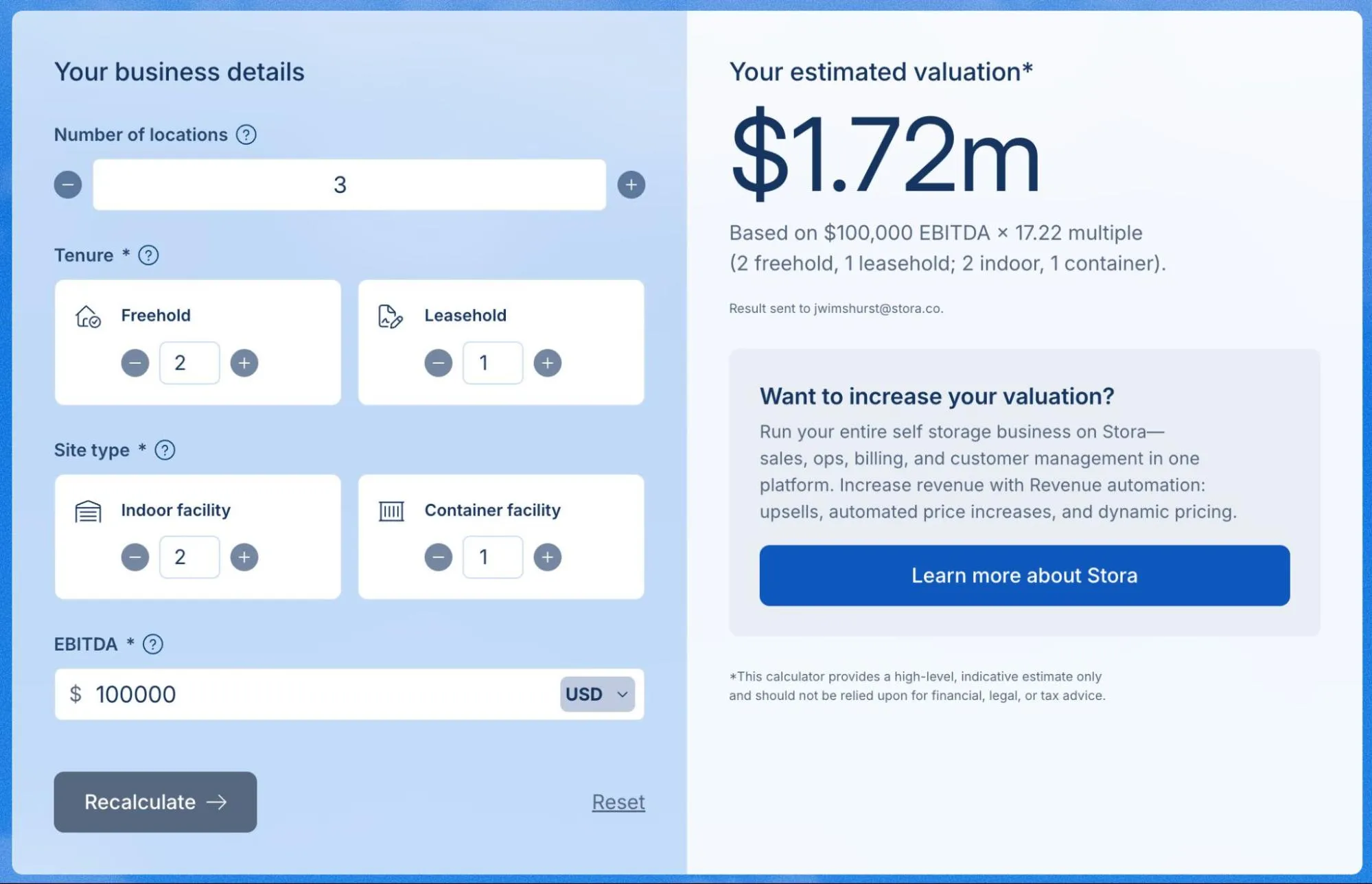
Stora’s valuation calculator shows how much your facility could be worth based on its income, expenses, and occupancy. It enables you to pressure-test assumptions or compare opportunities before investing in self storage.
If you want to improve the fundamentals behind your valuation, Stora is a self storage management platform built to support day-to-day operations and long-term performance.
It helps you to automate many aspects of your business, from marketing and booking to facility management and payments. This helps you grow revenue, improve efficiency, and provide a better customer experience.
Book a demo to see how Stora helps you run a more efficient and valuable self storage business.