
Technology, scale, and institutionalisation: global perspectives in local markets
The major trends redefining the industry — from digitisation to operational innovation — and how these shifts are influencing investor behaviour.
Referent

Ollie Saunders
Savills
Key takeaways
- Self storage is a real estate business as much as a technology one. New, digitally-enabled fourth-generation buildings out-position dusty legacy sheds.
- Capital is reallocating to “beds and sheds”. Storage can raise rents while technology lowers operating costs — a cash-flow shape no other real estate sector matches.
- Yield management is the under-used lever. European self storage delivered around 4.4% rental growth against 1.6% for traditional real estate. Operators are too timid on existing-customer rate increases.
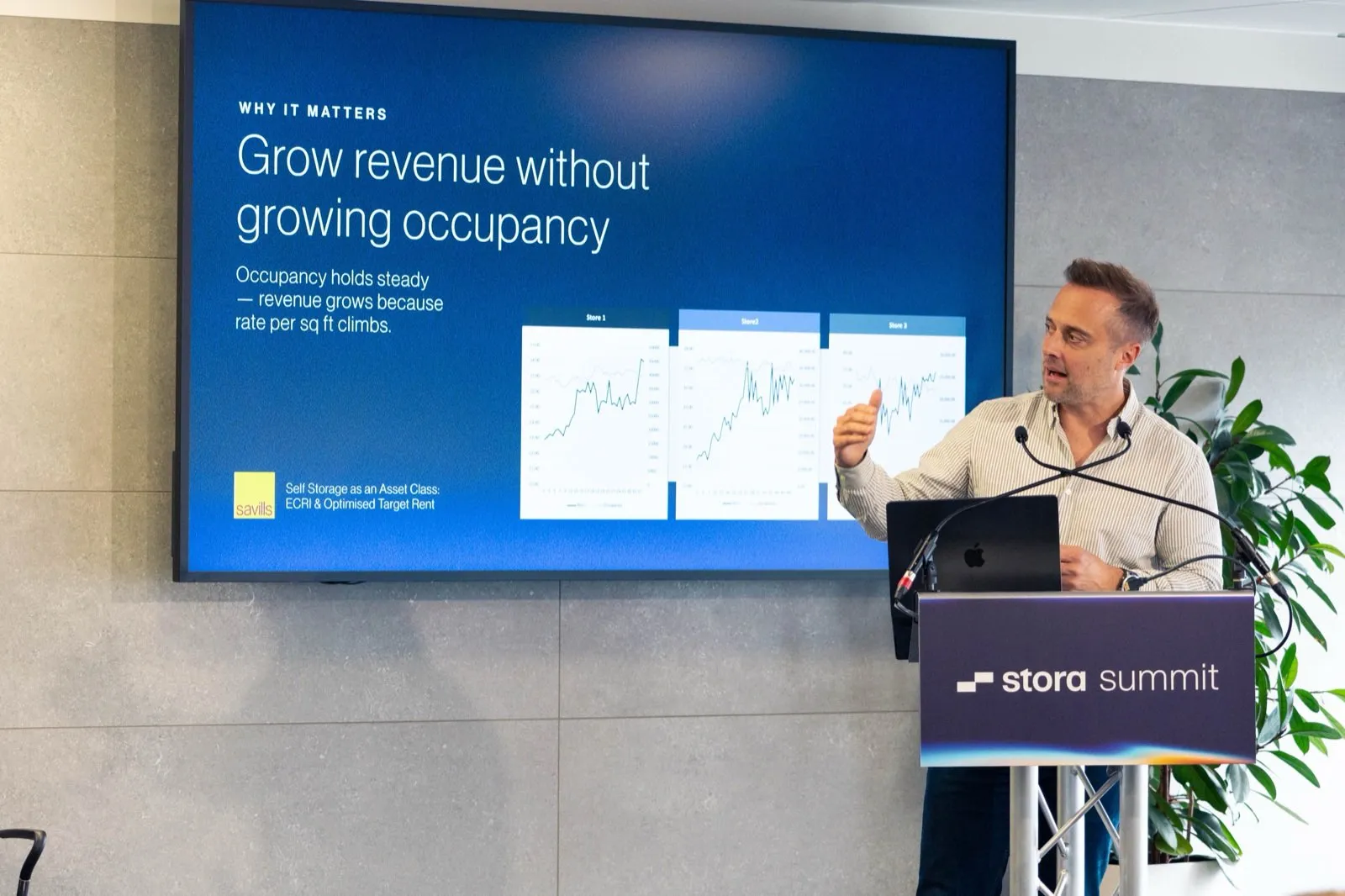
- Revenue-maximise, don’t occupancy-maximise. 75% occupancy at a higher rate can beat a full store.
“Please put your rents up when you go home.” — Ollie Saunders, Savills
Full transcript
This transcript is auto-generated, so it may contain errors.
Aled Bidder: Welcome back everyone. I hope you've had a lovely lunch. So moving on to the afternoon session, I'd love to bring Ollie Saunders on stage.
Ollie is a leading real estate professional in self storage working across the UK and EMEA since the 1990s. He brings firsthand transactional experience and creativity alongside analytical evaluation rigor and deep sector knowledge. He'll explore the major trends redefining the industry from digitization to operational innovation and examine how these shifts are influencing investor behavior. Thanks Ollie.
Ollie Saunders: Well good afternoon and amazing to see so many of you here. It's a fantastic conference and I think it's a great idea and it's a superb venue as well.
And I just like to start off by saying that everything that Gavin says about AI and the future of self storage I absolutely fundamentally agree with and I think he's very insightful in what he's doing and the change that is coming in to this industry.
I started working in the industry in the late 1990s. I was 10 years old at the time, just for the record. And what we've got now is basically some self storage, some property companies that happen to have some self storage operations. And it does raise me well and they make some money out of redevelopment. But we've also got the emergence of some really good new operators that I think are challenging what we would call some of the legacy operators in the UK and across Europe. And I think there's a tremendous amount for the young and older entrepreneurs in this industry to do really well. And a lot of those self storage platforms did well because they bought cheap real estate in the 1990s after the property crash. Self storage, they tried it and it sort of worked. And they went on to scale sort of platforms which would be say 20 or 30 or 40 assets and they lived on the income. It was fantastic. And in those days it was really easy to do self storage marketing because you just had to come up with a really good name that was top of the yellow pages. So there was a business called, Aardvark Self Storage, and I think that was brilliant because it's double A. So that was to get to the top of the Google rankings. You just have to be called A. So there's Armadillo and Acorn and various other things as well. And if you wanted to be really innovative you had an 0800 number in the UK, so it was free to call. So we used to phone up and they used to put you in. You didn't have to do that sort of transition pricing. You didn't have to do that transparency of pricing. But now what we're seeing after a great and successful industry is a period of real innovation and change as we are across all of our sectors of our economy, and we're seeing new innovation. But also seeing rising awareness, which is really good and we're also seeing much stronger competition coming into our markets.
So it's a much more crowded marketplace and when you say that self storage is really a tech business or a digital business, I also say it's a real estate business because the quality of your product really matters. And I think self storage operators that have got slightly dusty buildings that are 30 years old, that are at the end of an industrial estate, that have always been at 85% occupied rates, that are, say, 25 quid a foot, they're very happy. There is a real risk that the new capital that's coming into the market is going to build shiny, really good product that young people actually want to use, that is easy to birth, and there is a real risk of outpositioning some of these older operators in the marketplace and that's why we call them legacy. But also, when you look at the stats, I live my life on my iPhone and Copilot knows more about me than my partner, it's quite embarrassing really, and it tells me what to do like my partner does. But it's incredible. But in the Netherlands, 98% of people have bought something or a service online in the last three months, and in some countries like in Spain only 65% of people in Spain have actually bought something online. So we can go down the avenue that the future is tech and that people can order self storage on your sofa on the Saturday night and access, but I still think there is always a need for the manual, for the human interaction to be able to talk people in about the product. People still don't really know what they're doing with self storage, and there are very innovative ways to make yourself more efficient, but I don't think it's going to become a commoditized, automated process. You always are going to need that human being, the thing is that you're also going to probably need a lot less human beings. And I was in a meeting the other day, and somebody said, what's, tell me about AI and how it's going to transform self storage, and we're like, yeah it's great it's going to do all these amazing things. And what's the biggest risk of AI to self storage, and that client said the biggest risk is that 50% of the UK is unemployed and so we need to think about what that means in terms of employment and that wider piece as well. But I'm an optimist I think it's going to be amazing over the course of the next couple of years.
But I'm going to give you a reality check, because I'm in real estate, about what's going on out there, because I just, the news isn't great. Most of the time, and self storage is a real estate industry, we help create tremendous value across the real estate industry for owners and investors into self storage. And we had the COVID panic, which obviously meant that capital wasn't coming into real estate. We had a boom afterwards, then Putin decided to invade Russia, which wasn't great news. We then had a reasonably good period between 23 and 24, and then the orange man got into the White House and we had Liberation Day, which people just don't like uncertainty, so things stopped. And then we had the delights of Iran, and what that means if you're a real estate investor is that you want certainty, and if you are investing in things like offices, people are occupying offices as much as they used to. Retail, people are doing it online, they're not buying shopping centers or going to shopping centers as well, but what the graph shows in the bottom left, and I think the science will be circulated, is that investors are reallocating where they want to put their money. So they're buying living, so they're buying beds and sheds. So beds because this is new residential accommodation, sheds because that is where your Amazon package goes through. It doesn't go through a shopping center anymore, when you buy a pair of Nike trainers, it goes through an industrial shed as well. And there is increasing allocation of capital trying to come into self storage but we want to be really clear that the investors do not want some of this second-generation old kit at the end of the day, because they are worried about the future. And what they want to see is digitally enabled, fourth-generation, really green, shiny businesses as well. And that those are the people with the cheaper capital. There is also a good market for some of the older assets at scale as well, but you do have to get scale to get those exit values as well.
So the market in real estate is changing very considerably and raising capital is getting harder, so people want to deploy less capital into real estate as well. So for self storage to succeed, we need to keep saying what a wonderful business it is and it's the best thing in real estate, and that is why I do it. But also what's happening in the world is you can go and buy a Big Yellow share and it's really not very expensive, so, their net asset value is about 13 pounds. You can buy a Big Yellow share for 50% of what it's worth roughly, and Adrian is here and I'm sure he's got views, but that's the general sentiment in the real estate market. So we're seeing share prices fall, but one of the challenges of storage is that when you develop self storage, it costs you cash. And what people often do is they recycle the cash that's coming out of their existing self storage assets to put into brand new self storage assets, and then you've got the operational losses as well. So it's a great value creator but, when you're scaling, sometimes it's pretty hard to get cash flow out of it. What we will say is that while capital markets are still quite tough, there are loads of lenders that want to lend you guys money if you're a self storage operator. So, the banks are there, they’re competitive over the market place, they like funding really good operators, they like backing good entrepreneurs as well. We can see that that is a real way that the industry is going to scale, so I'm going to get more optimistic now.
I completely depressed you about what's going on in the world, but last year in November we published this paper which is where we see the key trends going on in the self storage market, which is about technology, which is really important. It's about scale, so it's about how you get really big platforms, and about institutionalization and bringing new capital that's desperate to come into the market. So, I think you all know, that Access Self Storage was on the market. There are 11 people, but bid out or close to one billion pounds for that self storage platform, so there's a lot of people with a lot of money that want to buy self storage. And the challenge is how can you build the self storage platforms of the future. And this comment from David Reya, who's the CEO of BlueSpace, has got quite a lot of traction because what we're seeing with self storage is the rents do pretty well. And I'm going to talk to you about rents, and I'm going to tell you to put your rents up because it's really easy, isn't it, that's what I've heard. But what David, who runs BlueSpace in Spain, which is I think it's 110 assets now, they're going to go to 175 assets over the course of the next couple of years. They've entered Paris, they've gone to Milan, they're in Lisbon as well. As he said, “We continue to see rental growth across our markets coupled with robust occupancy levels.” So it's good, it's a great business to be in, and he says, “As the business grows, we gain efficiencies through size and technology. So with increasing income and lower operational costs, we see a crocodile jaw-shaped cash flow ahead of us so what storage in the future should be doing is,” the rents are rising and the operational costs are falling as you bring in tech, and your cash flow does that. So your revenue is improving and your margins are improving, and I can tell you for a fact there is no other sector in real estate that is able to do that. Their cost bases are rising, if you run a care home or if you run student housing, it's getting more and more expensive to run that. You're under pressure on rents because of oversupply, we are in a unique location because we are broadly an under supplied market with rising awareness, with efficiencies that tech is bringing into these businesses, and also if you've got 10 self storage assets your costs really start falling. So that is one of the secrets of self storage, and also tech probably.
Five years ago we thought tech just meant Janus / Nokē locks, and we thought it was, like, really exciting. Great, this amazing, “Hey, we're digital. This is a digital product.” And what I'm saying is, we work across Europe is the fundamental change in the industry that has been caused on the application of tech at scale. So stuff that we really like is the sophistication that tech is bringing in in terms of pricing. Now, not only in setting your street rate and actually whether you give a pound for the first month or 50% off, I don't think that really matters. What really matters is how you keep your customers, and how you do that yield management through your ECRI, your resisting customer rent increase and, actually I'll come on to rents in a sec, but quite often people are quite timid and I think tech is going to have a huge opportunity to enable every operator, whether you be a big operator like Shurgard or a small operator with one store in Middlesbrough, to do really well on your yield management and thinking about how the customer thinks. We've got great data through AI, how a customer's thinking and how do you monetize that, and how do you try and put your prices up as well.
So I think that journey is incredible, how AI is improving sales processes. So we're seeing AI listening to sales calls and prompting sales staff to make sure they’re being really effective in what they're doing. How AI is transforming decision making on real estate: so, should you build this new site here, or should you build this new site here? Clearly, you come to Savills because we'll give you that good advice, but actually, there's a lot of information out there as well for you to look at as well, and we'll come on to local markets.
And because I'm a real self storage geek, I read the Safestore accounts this weekend. It was really exciting, and what he said, this is Frederick Vecchioli, and you know, a huge platform across Europe, the biggest operator in the UK, they’re in seven countries across Europe, and I think this sort of encapsulates where we think the industry is going. He said, we accelerated the integration of advanced AI across marketing, pricing, and property development capabilities that smaller operators cannot replicate. Now, I think some of the smaller operators are going to be able to replicate that, because the tools will be at your disposal quite soon. We maintained our overall marketing spend at broadly flat percentage of revenue year-on-year, while enhancing inquiry capture. So, what percentage of revenue do you think sales stores spend on marketing? We're doing auction. Anybody think it's 10%? 10% over. I have 10%. Anybody think it's 11%? 9%? 8%? 7%? 6%? 5%? 4%? 3%? 2%? 1%? They spend nothing. It's 4% of their revenue. Okay, so, and I'll show you some benchmarks as well, and we see that ranging quite considerably, sometimes up to 10% as well. But when you're running a self storage business, look at how much you're spending on the marketing. And of course, you waste half of it, but you don't know which half you're wasting. But also, what's interesting to my point is he said, in pricing architecture, we developed our predictive modeling, which anticipates occupancy trends and churn risks. The operational productivity of our sales teams continue to improve with the use of inquiry conversion scoring models and automated sales course transcripts analysis to drive performance coaching and, ultimately, revenue generation. And Safestore think you still need call centers, that it will, you still need that human there as well.
We're working with another business in Europe. They've stripped out every single member of staff in store, okay, and they've replaced them with facilities managers and sort of hub managers who drive around, and that performance is pretty good. Their costs have been reduced dramatically. The question that we have is, if you did put staff back into store, I think you will probably understand your customer a little bit better, and you have more human interaction as well. And if you do have the customer, if you do have somebody in store, will you be driving some of those revenues? Will you get that extra euro per square meter or pound per square foot that we need to do? And I think the industry doesn't really know what the definitive answer is. People are going to try different experiments. It's a wonderfully entrepreneurial community, so experiment, try with these things as well.
But also, a big trend that we can see is that it took 31 years to build Shurgard to 1.9 million square meters of space. If you look at Rafter Group, they've been going for 7 years and they've got nearly half a million square foot. They've got 70 sites across five countries. Bluespace has been going for 24 years. Storage24, which is drive-up, they've got a third of a million square meters of space, three and a half million square foot, which is the size of Access, and they've done that in 11 years as well. Big Yellow, with their funding model, you know, hugely respected business, they've only got point seven million square meters of space in 28 years of operation. And the way this is being done is that you've got investors that want to back really good entrepreneurs, who really want to scale it, and you've got investors who are long-term in their view, who are happy to fund developers as well. So the funding model is changing. The banks are there, and I think we can safely see that, over the course of the next ten years, there will be five portfolios in Europe that will have more than five, sorry, there'll be three portfolios in Europe that have more than 500 assets, because of the benefits of scale and actually putting these portfolios together and really going fast. So there's a lot to play for, and this is the quality of product that we think is really good that institutions want.
An interesting point in the market is we have a lot of very nice new buildings that are filling, and we've got a lot of very older buildings that are currently full as well. But these businesses perform very well. It's got really strong ESG criteria with the solar panels on the roofs. It's a really efficient building to run, and the operational costs of those buildings are really low on a per square meter basis when you look at it, and the development yield is some of the best that you can get in the real estate market. So you can choose to build a shed on it. You can build a shopping center. You can build a student housing block. Self storage is still one of the best performing property development assets there is in real estate as well. But also, everybody thinks you're doing quite well, and these slides, again, will be shared as well. But also, how much you're spending per square meter relative to your peers. Look at the difference in staff costs. Every operator runs their business on a very different basis, and there are huge efficiencies that can be bought through scale in terms of reducing those staff costs and reducing marketing spend is in scale those platforms as well. So there are big variations as well.
And I want to talk to you about rents, which is one of my pet topics about self storage. So across Europe, the long-term inflation rate in this period has been up 2.6%, and they're so surprised with that, they've fallen over. Wait till you hear this next point, they're going to faint. So traditional real estate has done 1.6, so real estate can't keep up with inflation, okay. So every pound of rent that comes out is losing its value if you invest in real estate. Self storage across a full spectrum has done 4.4% inflation beating growth. So again, it's one of the best performing asset classes. And one thing that I think is going to be amazing for tech is about how you do your management. So what is as important as what the price that you're winning the customer is, how long can you keep them, and how fast can you put those rents out, and what's their elasticity? When do they start screaming, and when do they actually leave, and how long do they keep going? And we work with several operators recently, and one operator across seven sites, we put the rents up by 50% on the 1st of January. So every customer got a 50% price increase, and the occupancy went from 97% to 94%. So our advice was wrong, because we should have doubled the rent, okay. And we often find, particularly with some of the smaller operators, this timidity on pricing, because you really don't want to lose them. But let me show you, and I think we should be sharing data on what ECRI existing customer rental increases are. So how much are you putting through? We need to be careful about reputation, because if you gave me a 30% price rise, I would tell my mates in the pub on a Friday night that that business there have absolutely slamming. But actually, what we're seeing is, you know, sophisticated models here.
So you've got a store here. This graph here, I wasn't expecting the room to be so big, so, but this line here shows the occupancy. The store stabilised here. What they did is they put the rents up, and actually, they were doing some bold experiments, because they took it from 13 to 16 in a relatively short period of time, and some people moved out, but not very many. And then they wanted to go for a bit more occupancy, so they crashed their price, and the occupancy went out, and then they played with pricing to find sort of the equilibrium. What is the right point for your local consumer as well? This store here, which is in the UK, they were stabilising at nearly 28 quid a square first, and they just went for it, and they put the rents to 37 pounds. And when they got to about 35, people started moving out. So what they realised is that's probably the natural level the consumer will accommodate as well. And this other store as well, what we saw here is they started at 45 pounds. They really pushed the rent up to 75 pounds, and actually, what they realised is they didn't have to have 85 or 80 percent occupancy at the store to revenue maximise. Actually, if they charge 75 quid at, let's say, 75 percent occupancy, it was way better than having a full store, okay. So it's all about revenue management.
And if we look at what Safestore have delivered in rental growth, so the UK column is pretty pants at the moment. The UK Safestore have delivered six and a half percent rental growth in the UK. Big Yellow have done 3.7, something like that as well. Different operators are having different challenges because the local markets they're in as well. But this is one of the secret sources of self storage in terms of yield managing, getting a low-churn customer base, and being aggressive on pricing, and I think AI will hopefully make people more sophisticated in what they want to do.
And self storage as an asset class, one of the reasons investors love it is that you don't, once you've built it, if you've built it well, is you don't actually have to spend that much CapEx on it, keeping it looking good. So typically, it's way lower than residential or offices. Offices wear out quite quickly. I know there's an office developer here as well. Previously, you have to keep refurbishing them. Tenants only take five-year leases. You have to spend a lot of CapEx. Self storage historically has not had to spend much. I think going forward, you have to have really good cutting-edge technology, really good security systems. Your building needs to look really good, because it is getting more competitive as well. So make sure that you keep your buildings always looking good, and I still think that the customer would value higher quality real estate assets and self storage than some dusty old shed at the end of an industrial estate as well.
But also, the self storage industry hasn't actually been that innovative until sort of COVID and digitization came in, because the model used to be that you all had to have a 45,000 square foot store because you had to employ three people to run it. And some businesses that we're seeing pop up across Europe include this concept, which is urban self storage in Spain. So the average size of this store, I think, is about 1,000 square feet, 100 square meters, and they have lots of very small corridors that fills typically within six to nine months. The rents are really good. It's all automated.
What is interesting is that when the customer first comes, they always ask to meet somebody to show them how to use the app and what it's all about. But once they're in, they're in. And the beauty of this is that your customers live directly above you, all within a five minute walking distance. So what you're doing there is that, if you've got two really big self storage facilities, these urban stores are coming into those catchment areas and beginning to take some of the local customers. So you no longer have to drive 20 minutes to a self storage building. You can walk five minutes to your self storage building, particularly in these high density urban areas. And this works well because commercial real estate is quite cheap at the moment, and they can buy these assets cheaply, and the yield on cost is through the roof.
So we're seeing a lot of innovation. We've seen drive-up self storage coming into the UK. So we have call that's opened in the UK. We've got some other operators that are coming through. Storage24 in Germany and France, they've got 160 drive-up self storage assets. They're 20, 20 square meters, 200 square foot. That business is worth over a billion, and it was funded by two brothers with some family money. So there are some real billionaires in this industry.
I think I should also, what's important about the industry, which I should have said at the beginning, is there are now eight platforms in Europe worth over one billion euros. So it's a big industry. They're also, at our last count, 21 self storage in, 21 self storage businesses that are worth more than 150 million. So it's a big sector that we're in.
But also, let's talk about micro markets, because we can talk about what Canadian pension funds want, and they want mega scale, and this is what's going to happen with technology. But self storage absolutely is a micro market. So the fact we're in London doesn't really matter. The fact is that we're in the London borough of Tower Hamlets, and what supply is within 50 minutes of this particular spot? So because it's the World Cup, we thought we do some sporting analogies. So we decided to build a self storage building on the Centre Court of Wimbledon, and if you were to do that, the local supply is about 3.58 square foot per capita, okay. So that is really quite high, and you've got new supply coming online. So we've got a small store coming out, which will be 35,000 square foot, and you've got access to a building, 128,000 square foot, down in Reigns Park as well. So do your homework, and can that market accommodate and absorb that level of supply? I think the answer is probably yes, for reasons I'll come on to. But we did this. I'd rather have a self storage building on the Emirates Stadium, because the local supply there is 2.42 square foot per capita. But also, look at the demand drivers. Where your customers actually going to come from? And actually, the reason we like around the Emirates Stadium is the population density is really high, okay. You've got lots of people. They're all living in very very small accommodation. Everybody lives in small apartments around that part. They don't live in large houses that you have down in Wimbledon.
You've got a lot of people working, okay. So they're all having children. They've all got cash. They've all got hectic lifestyles as well. The population is exploding, so it's growing at a phenomenal rate as well. And the downside is they don't move house that often, okay. So they are less likely to move house in that part of London, but the overall drivers are still pretty well as well. So in terms of making decisions about where you're going to be building your self storage platform, these are the types of things that you should be looking at. And actually, back into big data. So this is the supply of self storage across London where we are at the moment. So in Houndsloan Chiswick, which is where I live, it's the most, it's the most supplied bit of self storage in the UK, and at borough level, there's about 3.2 square foot per capita. But look at this opportunity out in East as well. So Newham and Redbridge. Redbridge has got a 0.3 square foot per capita of self storage, and it's got huge numbers of residential development there. So before you go to the clay shooting tonight, get on the tube and go to Redbridge and go find a site, because that is one of the best opportunities.
But also, this graph here, which will show you, shows the several cell storage school, which looks at its suitability relative to the supply. So actually, Islington is a standout market, because it's got one and a half square foot per capita, which is much better, which is the same level as Ealing. But actually, we like Islington because you've got massive high population density. People move house more often as well. So do your homework and think about where it's going to go. But there is plenty of opportunity to go for, because I'm really set. I'm going to tell you about a couple of things that have been going on, just to give you the scale of some of the transactions that happening.
So QuadReal, who are Canadian pension money, have put, called it, 250 million into Cinch Self Storage. They've got a further 600 million to deploy into the UK self storage market over the course the next couple of years, okay. So they're going to have another billion pound self storage operator in that market. They're going to benefit from tech and scale and great buildings as well. And Access Self Storage, you know, that is likely to train, change hands at some point in the new future. A capital and who owns self storage over in Asia are trying to buy that platform as well. They're going to start with one billion. They're going to want to take it to three billion. They're probably going to be looking at Europe. So this, these guys game is about technology, scale, and innovation. This is how self storage is going to go.
National Storage Australia, that was GIC in Brookfield, that was a six point five billion Aussie dollars. They call it three and a half billion pounds of assets that traded with real institutional grade product. National Storage affiliates, that was a 10 billion deal in the States, and that was interesting because what they were doing is they were buying self storage in stores in small towns, tertiary towns, as we recall them as well. But that benefits them because they are such a scaled platform in United States. That business has a market cap of about 60 billion dollars as well. So they benefit from being really really really big to drive those margins as well.
Nuveen, they've got a billion in the Nordics now, and they've done that through consolidation, consolidation using pension money from North America as well.
And Ardian, they've got assets in France at Italy. They bought Casaforte for a hundred million. They're doing stuff over in Spain, and again, they've got California and pension money that takes a really long-term view and loves the dynamics of self storage.
So it's a great sector. I think tech is going to be transformational, and it's going to really make sure that we got the next generation of self storage assets. So it's a great time. Listen to everything that Gavin says about AI. Think about pricing. Please put your rents out when you go home. That'd be great. That'd be really good as well. And keep sharing data and talking to each other about elasticity and what we can do with our customers as well.
But thank you very much.