

There are over 50,000 self storage facilities in the U.S. and over 3,000 in the UK. If you’re planning on investing in your own business, you’re up against some stiff competition.
However, if you manage your storage business well, you have a good chance of beating the competition and making a substantial profit.
Some entrepreneurs prefer to use a self storage management company to run their business, but we recommend starting with the basics yourself.
In this article, we’ll cover everything you need to know about self storage facility management.
Whether you’re an owner-operator, a facility manager, or an entrepreneur looking to start your own company, we’ll help you make your business a success and generate revenue.
What Is Storage Facility Management?

Source: Freepik
Self storage facility management is the combination of day-to-day operations and higher-level strategic decisions required to keep your site running smoothly, profitably, and safely.
It includes everything from customer service and bookings to maintenance, security, financial oversight, and long-term planning.
Good management is essential in an industry where performance varies widely.
- In the UK, the self storage sector generated £1.2 billion in turnover in 2024, with revenue per square foot rising to £29.13. Mature facilities operate at around 79% occupancy, while the overall UK market averaged 75.1%.
- In the U.S., occupancy levels are even higher, with many facilities averaging 96.5% (Source: Alan’s Factory Outlet).
Those margins make effective management critical: every additional percentage point of occupancy or revenue per unit can have a meaningful impact on your bottom line.
Strong facility management means balancing:
-
Operational tasks: Handling move-ins and move-outs, cleaning units, managing maintenance work, monitoring security systems, and supporting customers.
-
Financial management: Dealing with late payments, monitoring revenue, controlling costs, and tracking occupancy trends.
-
Strategic decisions: Setting pricing, monitoring revenue and occupancy trends, choosing marketing channels, investing in technology, and planning for growth.
To do this well, you need a mix of organisation, systems thinking, customer-centric communication, and the ability to interpret key performance indicators.
It’s also important to understand the KPIs that directly influence your business’s health.
For example, your physical occupancy may look strong. However, the revenue you actually collect, known as your “economic occupancy”, can lag behind. Some operators see a gap of 10–12 percentage points between these two figures.
Ultimately, good facility management protects revenue, reduces churn, and builds a better customer experience. These factors all contribute to a more resilient and profitable operation in both the UK and US markets.
Site setup and design considerations
The physical design of your facility directly impacts your operational efficiency, customer safety, and how attractive the business looks from the road.
Good design shapes the customer experience and, therefore, your long-term profitability.
This section explains what to consider when designing your facility.
Plan your layout for access and efficiency
Before finalizing your unit mix or site layout, it’s essential to complete boundary and topographical surveys and review any drainage or floodplain constraints.
These factors can significantly shape what’s feasible on your plot.
Site size also determines your design options. For example, in the U.S., single-story facilities generally need 4–5 acres to be economically viable, while multi-story developments can operate successfully on 2 acres or less.
Your facility’s footprint is a critical factor, as it influences your drive-aisle width, building placement, and even your ability to scale.
Make curb appeal a priority
Curb appeal plays a big role in attracting customers and signaling professionalism. Well-kept driveways, clear signage, tidy landscaping, and modern lighting all help create a positive first impression.
These features aren’t just cosmetic; they can also reduce long-term repair costs. For example, poor lighting could lead to accidents in your parking lot.
According to Inside Self Storage, a well-maintained site can significantly reduce costly repairs and replacements.
Design for smooth customer movement
The way customers move through your facility affects both their experience and your operational workload.
Wide drive aisles, intuitive traffic flow, and uncluttered access points make loading and unloading easier.
Inside the facility, well-lit corridors, clear directional signage, and secure entry points help customers feel safer and reduce the number of support calls your team receives.
Plan HVAC and energy efficiency early
Energy efficiency is a long-term cost consideration. If your facility is climate controlled, then HVAC planning should be factored into your design from the start. This can help you reduce your costs by around 30%.
Consider container vs. indoor unit design
Shipping-container storage is an increasingly popular option due to its speed of deployment and lower upfront costs.
However, containers come with unique considerations such as ventilation, insulation, and site layout.
Indoor facilities, by contrast, often offer better climate control, stronger security, and a more premium look and feel.
The right choice depends on your audience, budget, and long-term plans.
Build with scalability in mind
A well-planned facility can grow with demand. Leaving space for additional buildings, planning utilities with expansion in mind, and using modular layouts make it far easier to scale without disruption.
Even if you open a facility with a small footprint, thinking about how you will grow in the future will save you money and complexity in the long run.
Sales and Marketing

Source: Freepik
Sales and marketing are critical to the success of self storage facilities because they drive occupancy rates, generate revenue, and help your business stand out in a competitive market.
Currently, many self storage facilities don’t do a good job of marketing themselves. This is shown in the fact that only 43% of the population is familiar with self-storage services, highlighting a significant awareness gap that marketing must address.
Effective sales and marketing strategies attract new customers and retain existing ones, ensuring your self storage units remain rented.
The key element of marketing your self storage company is driving potential customers to your website to learn about your offering and book their storage units.
Let’s look at three marketing tactics you can use to drive traffic to your website and get more bookings:
Customer segmentation and target markets
Understanding who uses your facility and why is one of the most effective ways to improve your marketing and increase occupancy.
Different customer groups have different motivations, storage timelines, and price sensitivities, so tailoring your messaging to each segment helps you reach more people with less wasted spend.
Understanding these segments helps you tailor advertising, promotions, content, and even your facility layout.
It also improves the customer experience. When people feel like your service is built for their specific situation, they’re more likely to choose your facility and stay longer.
In most markets, residential customers make up the majority of demand. In the U.S., for example, around 73% of customers use self storage for personal reasons. But even within these broad categories, there are multiple sub-segments worth targeting separately.
Here are the most common customer groups and how to tailor your marketing to them:
-
Residential customers: This includes people moving house, renovating, downsizing, divorcing, or simply short on space. Your messaging should focus on convenience, flexible unit sizes, and easy access.
-
Business customers: Retailers, tradespeople, e-commerce sellers, and contractors often need secure inventory storage. They typically value reliability, longer-term contracts, and features like extended access hours or drive-up units.
-
Students: These customers are particularly active during the summer and winter breaks. Offer smaller units, clear short-term pricing, and simple online booking.
-
Seasonal and holiday storage users: People often need a place to store garden furniture, sports gear, and other seasonal items. You can attract these customers by highlighting ease of access and flexible rental periods.
-
Life-event users: Customers responding to major life changes such as bereavement, relocation, or separation. Clear, supportive customer service and frictionless onboarding will appeal to these storage users.
➡️ Pay-per-click (PPC) ads
You can use advertising platforms like Facebook ads or Google Ads to target local customers searching for self storage facilities. This type of marketing is called PPC advertising, and it can help you reach a highly specific audience.
The average return on investment (ROI) for PPC is 200%, making it a good investment for your business.
➡️ Social media advertising
Almost 60% of social media users check their profiles daily. Leverage social media to promote your self storage facility by creating engaging posts to showcase your services, customer reviews, and discounts or promotions you’re running.
➡️ Search engine optimization (SEO)
Search engine optimization refers to optimizing your website to ensure people can find it when they use search engines to look for something.
More than 68% of online experiences begin with a search engine, so you must ensure your site is visible in search results.
Optimizing your website may improve its ranking in search engine results pages (SERPs), increasing the chances of local customers finding it and opting for your services.
➡️ Customer relationship management (CRM) platforms
Previously, self storage facilities had to use cold calling and similar tactics to attract new customers. However, much of the sales and marketing process can now be automated and handled remotely through your website alongside a CRM.
Most businesses see their sales and revenue increase by 21% to 30% after implementing a CRM platform.
Using a CRM like Hubspot means you can:
👉 Capture leads when people visit your self storage facility’s website.
👉 Store these leads and track them.
👉 Send automated emails to follow up with customers and share more details about your facility.
👉 Send discounts to people who haven’t yet rented a unit.
Taking Bookings

Source: Freepik
Customers prefer facilities with a seamless booking process, especially when they are in a hurry to rent a self storage unit.
An intuitive online booking system ensures customers can check availability, compare unit sizes and prices, and reserve a unit without hassle. This also means they don’t have to visit your facility in person to make a booking.
A booking system integrated with your website can help you manage reservations, keep track of available units, and give you a clear view of your occupancy rates.
With the right software, you can connect your booking system to the locking mechanism on your self storage units.
This means customers don’t have to visit your site to collect keys. Instead, a code is sent to their mobile phones that allows them to open their units themselves.
Here are some tips for ensuring your booking system is efficient and attracts customers:
Presenting unit sizes and prices clearly
How you present your units impacts conversions. Clear pricing, visual size guides, and transparent feature comparisons help customers make decisions without having to call your facility.
Simple changes like showing the most popular unit first or recommending units based on typical use cases can improve conversion rates and reduce abandoned bookings.
Use automation to update unit availability in real time
Your booking system is one of the best parts of your business to use automation.
For example, when a customer books a unit, you can update availability in real time. This prevents double bookings, manual errors, and customer frustration.
It also improves efficiency and sales, as rooms can be rebooked as soon as the previous customer leaves.
Automation also removes manual tasks from your team. For example:
- Auto-assigning a unit after a booking.
- Triggering an automated move-in email.
- Sending customers their access code.
- Updating occupancy dashboards.
This level of automation is increasingly becoming standard, with 73% of U.S. operators now considering automation “critical” to their business.
Handling online bookings and walk-ins
Not every customer will book online. Some will visit your facility, call for pricing, or stop by while driving past. Your booking system should support all of these scenarios:
- Let staff complete bookings on tablets or desktops.
- Keep availability synced in real time.
- Prevent staff from accidentally reserving an already-booked unit.
- Make it easy to convert walk-ins into online profiles for future communication.
Linking bookings to access control
When your booking system connects directly to your access control solution, your move-in process becomes almost entirely self-service.
For example, after booking:
- Customers receive a confirmation..
- They e-sign the lease.
- Their ID is verified.
- A unit is assigned.
- An access code is issued automatically.
This eliminates the need for customers to collect keys or meet a staff member on-site.
Website Management

Source: Freepik
A good website is essential for self storage facilities because it acts as a digital storefront, often making the first impression on potential customers.
Just as a well-maintained physical storefront attracts walk-in customers, a professional and user-friendly website draws online visitors and converts them into paying customers.
Beyond conversions, your website is also the ideal place for customers to make bookings and manage their storage services. It makes things convenient for them and provides an excellent customer experience.
Websites that are well-managed and perform well can achieve conversion rates above 10%.
Below are some of the ways you can manage your storage facility website to drive conversions and convenience:
💻 Plan downtime at a convenient time
Website downtime for maintenance or updates is sometimes necessary, but planning it during periods of low traffic, like midnight or weekends, ensures minimal disruption for customers trying to make bookings or access information.
💻 Install updates and patches
Updates and security patches are essential to protecting your website from vulnerabilities. Hackers often target outdated systems, so timely updates safeguard sensitive customer information, such as payment details and personal data.
Many updates include performance enhancements, bug fixes, and improved functionality, ensuring your site runs smoothly and offers an optimal user experience.
💻 Ensure your information and pricing are up to date
Accurate pricing and unit availability builds trust and reduces customer frustration. Outdated or incorrect information, such as showing unavailable units as available, can lead to a negative perception of your facility and even lost business.
💻 Keep your content updated
Search engines favor websites that consistently update and refresh their content. Regularly updating blog posts, FAQs, and your service pages helps maintain or improve your rankings in search results.
Updating blog posts and other older content can increase your traffic by nearly 96%.
Additionally, regularly adding helpful content to your website, such as storage tips, moving guides, or seasonal advice, can attract and retain customers.
💻 Build trust online: photos, videos and reviews
Your website should quickly build customer trust by showing them what they can expect when renting a unit. When customers see clear evidence of a well-run facility, they’re more likely to book.
High-quality visuals and real customer feedback are one of the best ways to do this.
Use high-quality photos to show your facility
Clean, clear, well-lit images reassure customers that your facility is modern, safe and professionally maintained.
Aim to show:
- The facility entrance and gate.
- Your office or reception area.
- Drive aisles.
- A sample unit (open and empty).
- Any additional amenities, such as climate control, loading bays or trolleys.
Think of these images as your digital curb appeal. If the facility looks tidy and welcoming online, customers are more likely to trust that their belongings will be safe in your care.
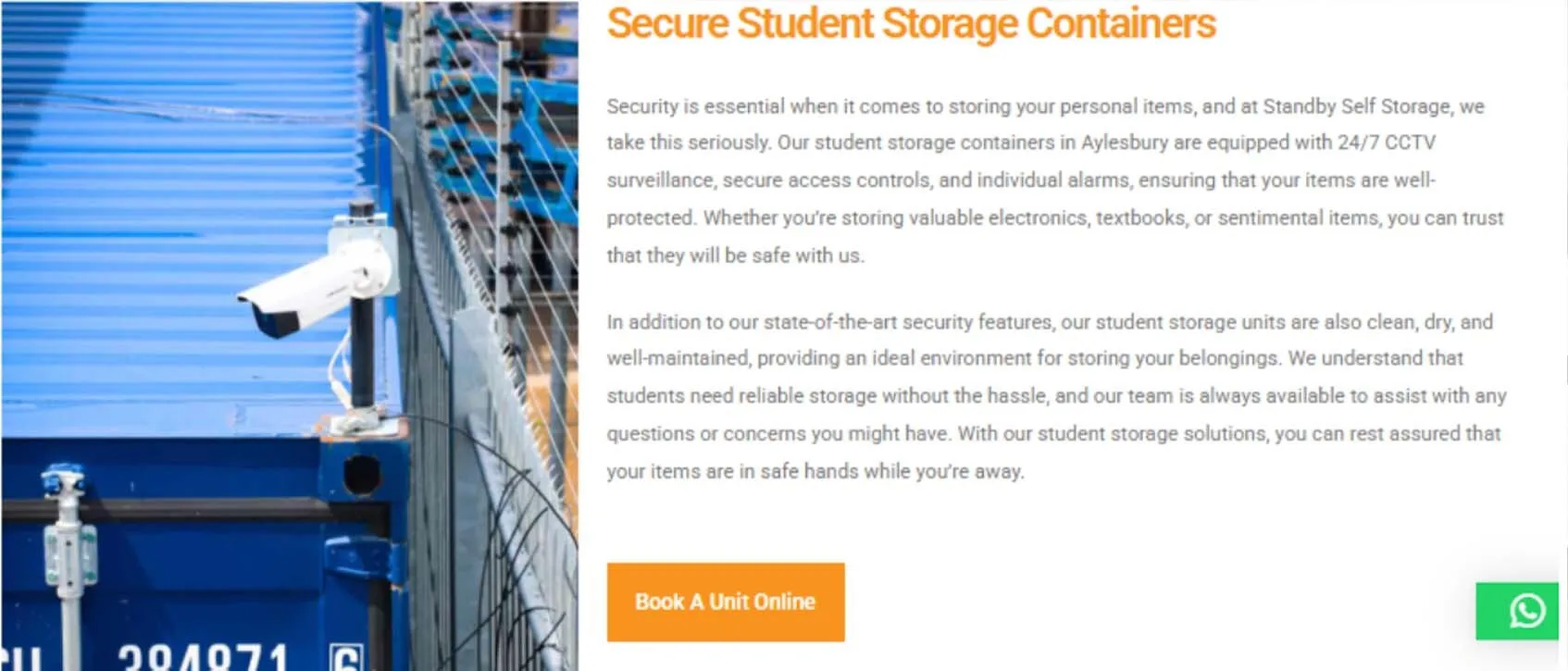
Stora customer Standby Self Storage includes high-quality images of different aspects of each facility.
In the example below, its section discussing the security measures for student storage at its Aylesbury location includes an image of one of its security cameras. This reassures potential customers that the site is secure.
Add video walkthroughs or drone footage
Video adds an extra layer of transparency and credibility. This could be a simple walkthrough recorded on a smartphone or a more polished drone video showcasing your facility from above.
Even basic videos help customers understand:
- How easy it is to drive around the site.
- Gate access and entry points.
- The general layout of your property.
- How units look and how big they feel in real life.
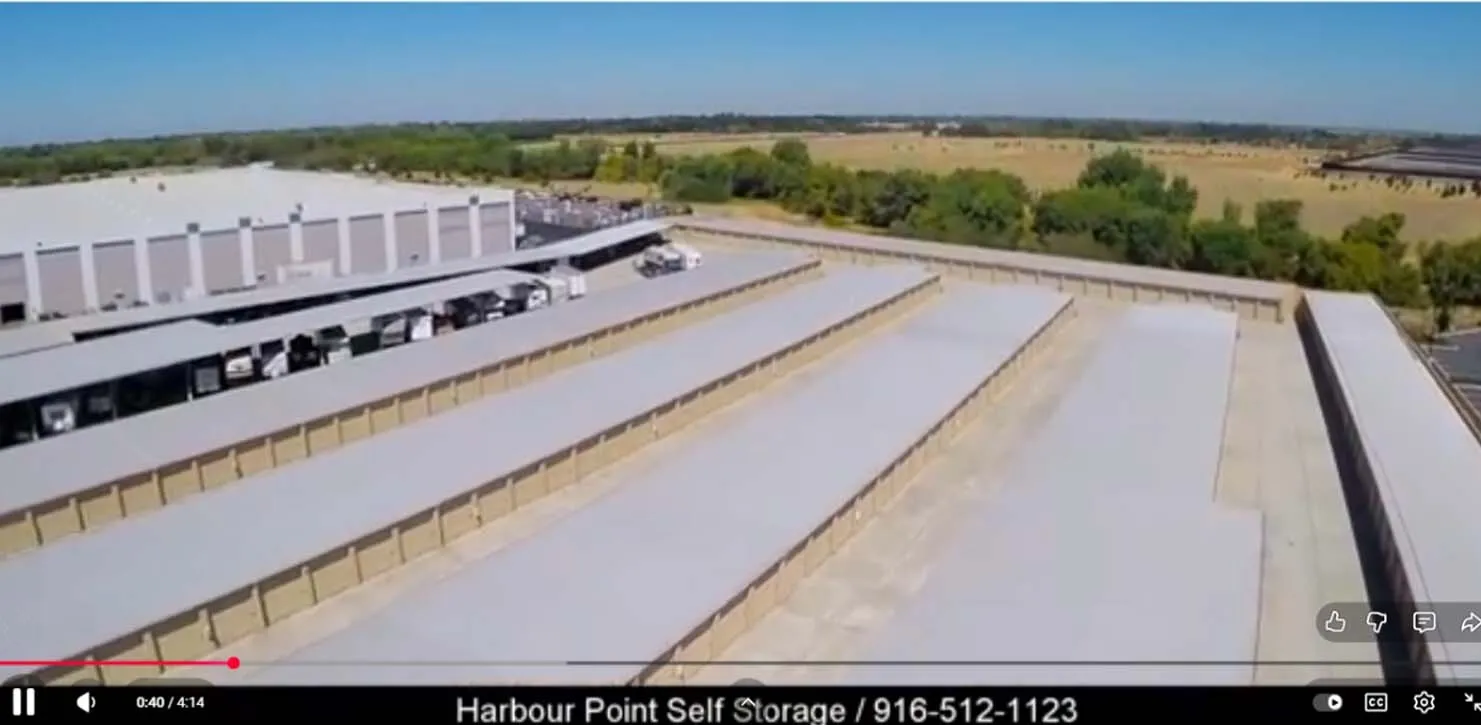
Videos also answer questions. For example, a video showing a moving truck driving through your facility demonstrates that this is possible, saving potential customers from having to ask.
This video from Harbour Point Self Storage gives an immediate feel for the scale and layout of the company’s facility.
💻 Showcase customer reviews prominently
Reviews are one of the most powerful proof points you can display. They show potential renters that others have had a positive experience and help validate your claims about security, cleanliness and customer service.
A survey of storage users found that 38 percent of people read reviews before choosing a facility. Featuring Google reviews on your website makes it easier for customers to trust you, especially when they’re comparing multiple facilities in the same area.
Include:
- Your overall Google rating.
- Selected reviews that mention cleanliness, convenience or customer service.
- Recent reviews to show you consistently deliver quality.
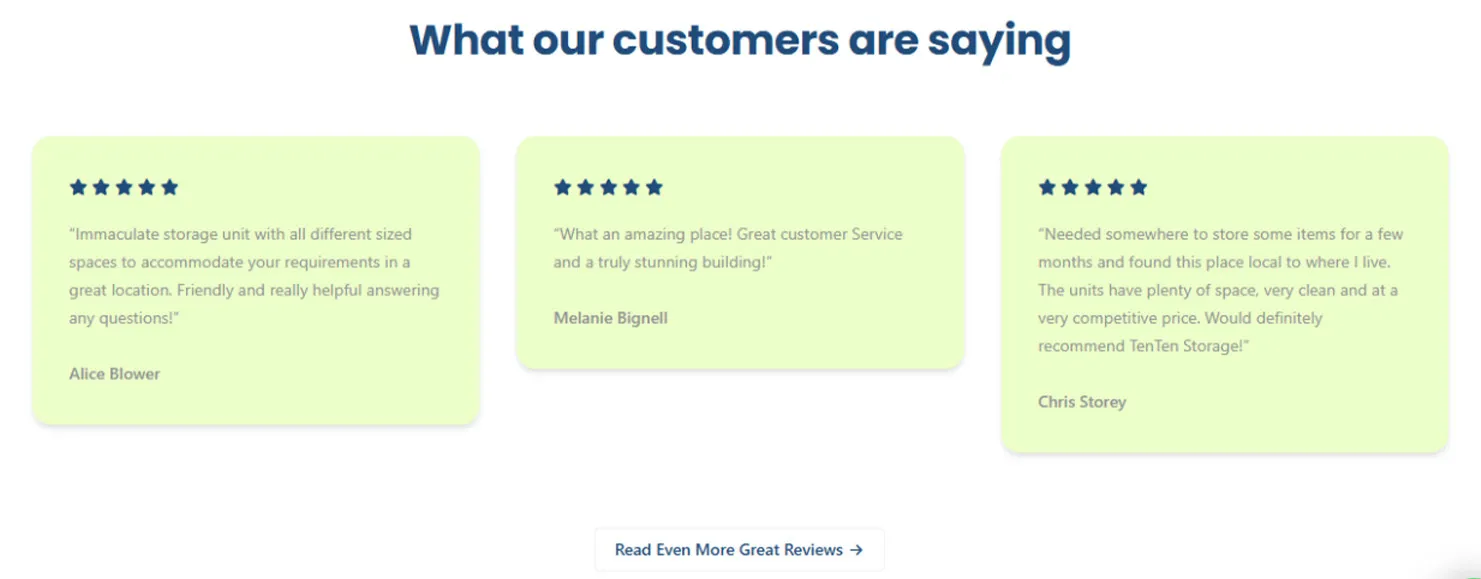
Stora customer TenTen Storage displays its reviews on its homepage and makes it easy for people to find more. This shows that the company is transparent with its feedback and proud of its record.
| ⭐️ Get the Ideal Self Storage Website with Stora
Stora is an all-in-one self storage management tool that offers comprehensive website design services. Our websites are expertly designed to generate leads, drive conversions, and rank well in SERPs.
Customer Onboarding

Source: Freepik
In the past, onboarding new customers meant self storage facility owners or their staff had to show them around the site. As mentioned earlier, it also meant that customers had to visit self storage properties to sign their leases and collect their keys.
Now, using the right automation software, customers can access their units via an app or a code. This can enhance operational efficiency and satisfy customers.
Another way to streamline onboarding your customers is to send them comprehensive videos and how-to guides on accessing and using their storage units so that you don’t have to walk them through this in person.
Servicing Customers

Source: Freepik
Customer service is the cornerstone of success for self storage facilities. Beyond offering secure and easily accessible units, facilities must prioritize exceptional customer service to build trust, foster loyalty, and maintain a competitive edge.
You need to ensure your staff can be easily contacted via phone, email, or online chat to help customers at a moment’s notice. This is known as omnichannel support, which can turn 89% of customers into loyal ones.
You should also provide up-to-date and clear contact information on your website and within your facility so that customers can reach you whenever they need to.
Additionally, you may want to consider maintaining a physical presence at your storage facility.
Below are some pros and cons of doing so:
The pros of having a physical presence
✅ Personal interaction: In-person communication allows your storage manager or other staff to address customer inquiries, resolve issues, and provide a personal touch, fostering trust and loyalty.
✅ On-the-spot assistance: Staff can immediately assist with tasks such as explaining unit sizes, helping customers access their units, or troubleshooting issues like tech malfunctions.
✅ Enhanced security: A physical presence may discourage theft and vandalism as customers and potential intruders know staff are on-site.
The cons of having a physical presence
❌ Higher operational costs: Employing on-site staff adds to labor costs, particularly if coverage is required during extended hours.
❌ Facility expenses: Providing amenities for staff, such as office space, utilities, technology, and break areas, increases overhead expenses.
❌ Dependent on staff availability: If staff are unavailable due to illness, vacation, or turnover, customer service and operations may be disrupted.
Facility Maintenance

Source: Freepik
Maintenance can extend the lifespan of your facility’s assets by up to 33%. Storage facility maintenance is the ongoing tasks and processes required to ensure the property is safe, clean, functional, and aesthetically pleasing to your customers.
This includes both routine upkeep and addressing unexpected issues to maintain high standards of operation.
Maintenance tasks typically include:
- General cleaning: Keeping units, hallways, and common areas clean and free of debris.
- Repairs: Fixing damaged unit doors, locks, gates, lighting, or other equipment.
- Pest control: Preventing and managing infestations to protect stored items.
- Security system checks: Regularly testing surveillance cameras, alarm systems, and access control systems.
- Facility inspections: Checking for structural issues, leaks, or signs of wear and tear.
- Upkeep: Ensuring the facility looks appealing and well-maintained, both inside and out.
Chasing Late Payments

Source: Freepik
Over 55% of invoices issued in the U.S. are paid late. When customers don’t pay on time, it can become a big headache for storage facility managers. It also impacts your revenue and the amount of admin you have to do.
Using the right automation tools allows you to automatically overlock units when monthly rentals aren’t paid. This means that your customers can’t access their units until they make a payment.
This saves you time and resources and makes customers responsible for access to their units.
With Stora’s auto overlocking feature, your storage units will automatically be unlocked to reactivate access once a payment clears.
Security

Source: Freepik
Storage facility security is the measures and systems you put in place to protect your property, customers’ belongings, and the overall operation of your facility from theft, vandalism, and other security threats.
Effective security creates peace of mind for customers and ensures your self storage facility’s reputation and operational integrity are upheld.
So, what does storage facility security involve? Let’s unpack a few key aspects:
🔒 Regular maintenance of security equipment: All security systems, including surveillance cameras, access control systems, alarms, and lighting, must be regularly inspected and maintained to ensure proper functioning.
🔒 Proactive repairs: Faulty equipment, such as a broken gate keypad or malfunctioning camera, should be fixed immediately to avoid vulnerabilities.
🔒 Periodic testing: Conducting routine tests of alarms, locks, and access control systems ensures they respond as expected in emergencies.
🔒 Active surveillance: CCTV cameras should be strategically positioned to monitor critical areas, including entrances, exits, storage units, and communal spaces.
🔒 Remote monitoring: Advanced security systems allow staff or third-party security companies to monitor your facility remotely, ensuring it is always under watch, even during off-hours.
🔒 Timely response: When an alarm is triggered, or suspicious activity is detected, staff or your security personnel should respond quickly and assess the situation.
🔒 Emergency protocols: Clearly defined protocols for responding to break-ins, vandalism, or unauthorized access ensure quick and effective action.
Monitoring Performance

Source: Freepik
Regularly monitoring key performance metrics, such as occupancy rates and storage facility ROI, is crucial for the success and profitability of your business.
These metrics provide insights into your business’s financial health, operational efficiency, and market competitiveness.
Tracking occupancy rates helps identify seasonal patterns, periods of high demand, and underperforming times. For example, the most demanding time of year for self storage is May through September, the most common season in which people move into new homes.
This information allows you to adjust your pricing strategies, like discounts or dynamic pricing—to optimize revenue.
If your metrics indicate your business isn’t performing well, you can adjust your strategy to ensure profitability.
Having the right self storage software in place and ensuring that as many of your systems are integrated with it as possible will help you measure your key business metrics.
Why Stora Is the Only Tool You Need to Manage Your Self Storage Facility
Stora is an all-in-one self storage facility management tool that allows you to automate your entire business.
From your website to sales and everything in between, Stora makes storage management practically hands-free.
Some of the features we provide to help you manage your storage facility include:
✔️ Auto reservation: Our software automatically allocates units to any new bookings from your website, making one-minute move-ins possible.
✔️ Auto access: You can connect your smart entry system with our tool to give customers access to their units via an app or with a code.
✔️ Auto availability: Your storefront will always be set up to match your unit availability. Stora will switch the status of any unit type to collect bookings or leads to match if units are available or not.
✔️ Overlocking of units: Set Stora to instantly lock out tenants whenever they miss a payment and automatically reactivate access once the payment clears.
✔️ Key business metrics: Stay updated with real-time insights into your key metrics. You can monitor current occupancy, keep track of your month-to-date revenue, and manage outstanding balances.
✔️ Tools for day-to-day operations: Manage your property and get instant access to site maps, as well as upcoming move-ins and move-outs.
Request a free Stora demo and learn how our tool can simplify self storage facility management.