


The UK is a nation on the move, with over 2.1m Brits moving across the country each year.
Some are crossing borders with over a quarter of a million packing up and moving to countries like Spain, Australia and the US in 2024 - and 23% planning to move abroad in the next five years. Young people are motivated by job prospects and a better quality of living overseas, while over a third (39%) of expats emigrated because of the rising cost of living.
It’s no secret households are battling rising costs and property prices, so money could be the motivation for some people searching for cheaper postcodes. That could take London out of the equation because it’s the fourth most expensive city to live in globally, and 860,000 people decided to leave in 2023.
Some of the reasons people feel compelled to move to new towns is to improve access to transport, healthcare, shops, jobs and green spaces.
It’s a stark contrast to the pandemic days when people were moving to coastal and rural areas like Cornwall and Kent, because of remote working opportunities and lower property prices compared to cities like London. But research shows fewer Brits are now moving away from cities, with homes in coastal areas taking 21 days longer to sell.
City life seems to be a key movement trend in the UK:
-
Retirees are moving to cities instead of villages because there is more to do
-
London is the most searched for location on Rightmove, with over half (58%) of its residents planning to stay
-
16% of first-time buyers are looking to move to cities compared to 2015
With self storage demand driven by national moving trends, we were keen to find out the most and least popular locations for movers in 2026. So we analysed over 50 cities and towns across the UK to find out where Brits are choosing to stay and leave, and where the demand for self storage may be highest.
Key takeaways:
-
Birkenhead is the most popular location for movers, with the highest net migration increase at 27%
-
Luton is the least popular location with more people choosing to leave than stay, and net migration at nearly -7,000
-
The six most popular locations for movers are towns, despite wider research suggesting people want to move to cities
Top 10 popular locations for movers
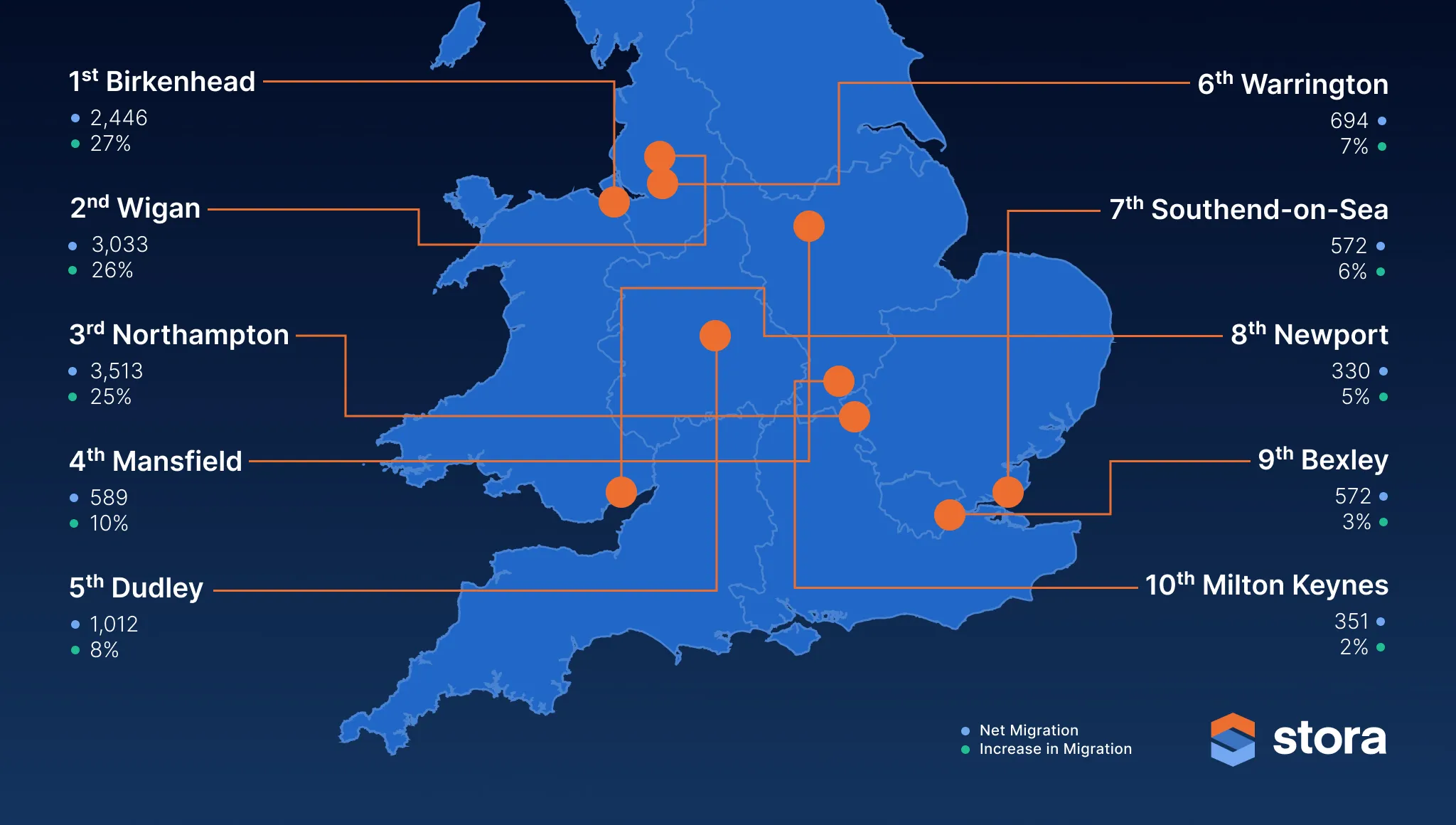
Despite 62% of Brits admitting they don’t like the idea of moving to a town, the top six relocation spots are towns in the UK, suggesting movers are compromising on their preferences. And out of the top 10 locations, 40% of movers settled down in the south of England, while 30% headed north.
| Rank | City | Net migration | Increase in migration |
|---|---|---|---|
| 1 | Birkenhead | 2,446 | 27% |
| 2 | Wigan | 3,033 | 26% |
| 3 | Northampton | 3,513 | 25% |
| 4 | Mansfield | 589 | 10% |
| 5 | Dudley | 1,012 | 8% |
| 6 | Warrington | 694 | 7% |
| 7 | Southend-on-Sea | 572 | 6% |
| 8 | Newport | 330 | 5% |
| 9 | Bexley | 572 | 3% |
| 10 | Milton Keynes | 351 | 2% |
Birkenhead has the highest increase in net migration at 27% in the year to mid-2024, with just over 11,000 people moving into the area and nearly 9,000 leaving. The port town is on the Wirral Peninsula and the banks of the River Mersey – just opposite Liverpool, with its job opportunities and leisure attractions.
The average house price in Birkenhead is £210,338, which is significantly lower than the national average of £272,000. But the average house price in Liverpool is significantly lower at £181,809, so movers may be willing to pay more for a peaceful lifestyle and close access to the city for work or leisure.
Wigan is the second most popular location to relocate, with net migration at 3,033 and an increase of 26%. Nearly 15,000 people settled down in the Greater Manchester town – possibly motivated by the low average house price of £187,000 and mortgage payments of £841.
Coming in third is Northampton, with net migration increasing by a quarter at just over 3,500. The average house price and monthly mortgage payments are higher in the East Midlands town at £255,130 and £1,147 respectively, but that doesn’t seem to faze movers.
Mansfield and Dudley – both towns in the Midlands – are also popular relocation hotspots with net migration at 589 and 1,012, respectively.
Least popular locations for movers
More people are choosing to move out of Luton than move in, so migration has dropped by -39% and net migration is negative at almost -7,000. The average house price is over £280,000, which is higher than the national average, and average mortgage payments are hitting £1,260 each month.
The second least desirable city for movers is Portsmouth – over 18,000 people left and net migration is -5,500. This follows the trend of people moving away from coastal areas but it could also be because of high average mortgage payments of £1,125.
Although Leicester is the largest city in the East Midlands, it’s not popular with movers, since net migration is -9,305. Over 31,500 residents have moved away, while just over 22,000 people moved into the city. House prices are significantly lower than the national average at £232,281 but mortgage payments are still over £1,000 per month.
| Rank | City | Net migration | Increase in migration |
|---|---|---|---|
| 1 | Luton | -6,932 | -39% |
| 2 | Portsmouth | -5,519 | -30% |
| 3 | Leicester | -9,305 | -30% |
| 4 | Kingston upon Hull | -3,660 | -24% |
| 5 | Slough | -2,972 | -23% |
| 6 | Bradford | -5,628 | -23% |
| 7 | Coventry | -6,865 | -21% |
| 8 | Birmingham | -16,373 | -21% |
| 9 | Oxford | -4,927 | -20% |
| 10 | City of Westminster | -4,956 | -19% |
Other standout stats:
- Birmingham has the highest number of people moving away, with over 79,500 residents packing up and leaving
- The City of Westminster is the most expensive location to live in, with an average house price of £976,519 and mortgage payments £4,391
- The lowest average mortgage across all of the locations stands at £586 in Blackpool
*“Our research reveals Brits are moving far and wide, with popular locations in the south and north of England. Naturally, demand for self storage could be higher in these locations as more people choose to make the move. However, the economy is uncertain and demand can change quickly, so self storage providers need to make sure they’re prepared to take advantage of increased demand if and when it arises.”
Gavin Shields, CEO at Stora
Five ways self storage companies can keep up with customer demand
Movement trends can be influenced by societal changes like the Covid-19 pandemic or remote working, but they can also be unpredictable, especially as cost pressures on households mount. In the self storage world, demand tends to follow the 4 D’s: divorce, death, displacement or downsizing.
But whatever the reasons, you need to be prepared to meet customer demand – self storage software can help you to respond quickly by automating processes and improving flexibility for customers.
Customers increasingly prefer the convenience of booking online rather than speaking to someone over the phone, so offering a range of options – such as online, text and phone – makes it easier for them to book in the way that suits them best and can help drive more bookings.
-
Offer flexible booking options: Customers value the convenience of booking online rather than speaking to someone over the phone, so offering a range of options such as online, text and phone makes it easier to book in a way that suits them best and can help encourage more bookings.
-
Enable dynamic pricing: Keep up with customer demand: As demand increases and units begin to fill up, the software automatically adjusts your rates, ensuring your pricing keeps pace with demand while helping you maximise revenue.
-
Automate move-ins: Empower customers to check in independently with software that automates everything from identity checks and contract signatures to facility access, all supported by automatic communication.
-
Set up recurring payments: By enabling recurring payments by card or direct debit, ensure payments are convenient and made on time – if there is a late payment, access can be limited automatically until the payment is made.
-
Overview of perfomance: Keep an eye on operations at a glance using a smart map, which updates you on the availability and status of units in real-time.
Methodology
Stora took the top 50 most populated locations and analysed where residents are choosing to move. Using the Office for National Statistics, we analysed inflows and outflows for each location to reveal the percentage increase in net migration.
In addition, we analysed GOV UK data to determine the average property cost in each location and the average monthly cost to see how much residents could be expected to pay if relocating.