
The autonomous storage business
Stora's view of the next era of self storage — an industry becoming increasingly autonomous, where every non-physical process can run itself — and what we're doing to take it there.
Ponentes
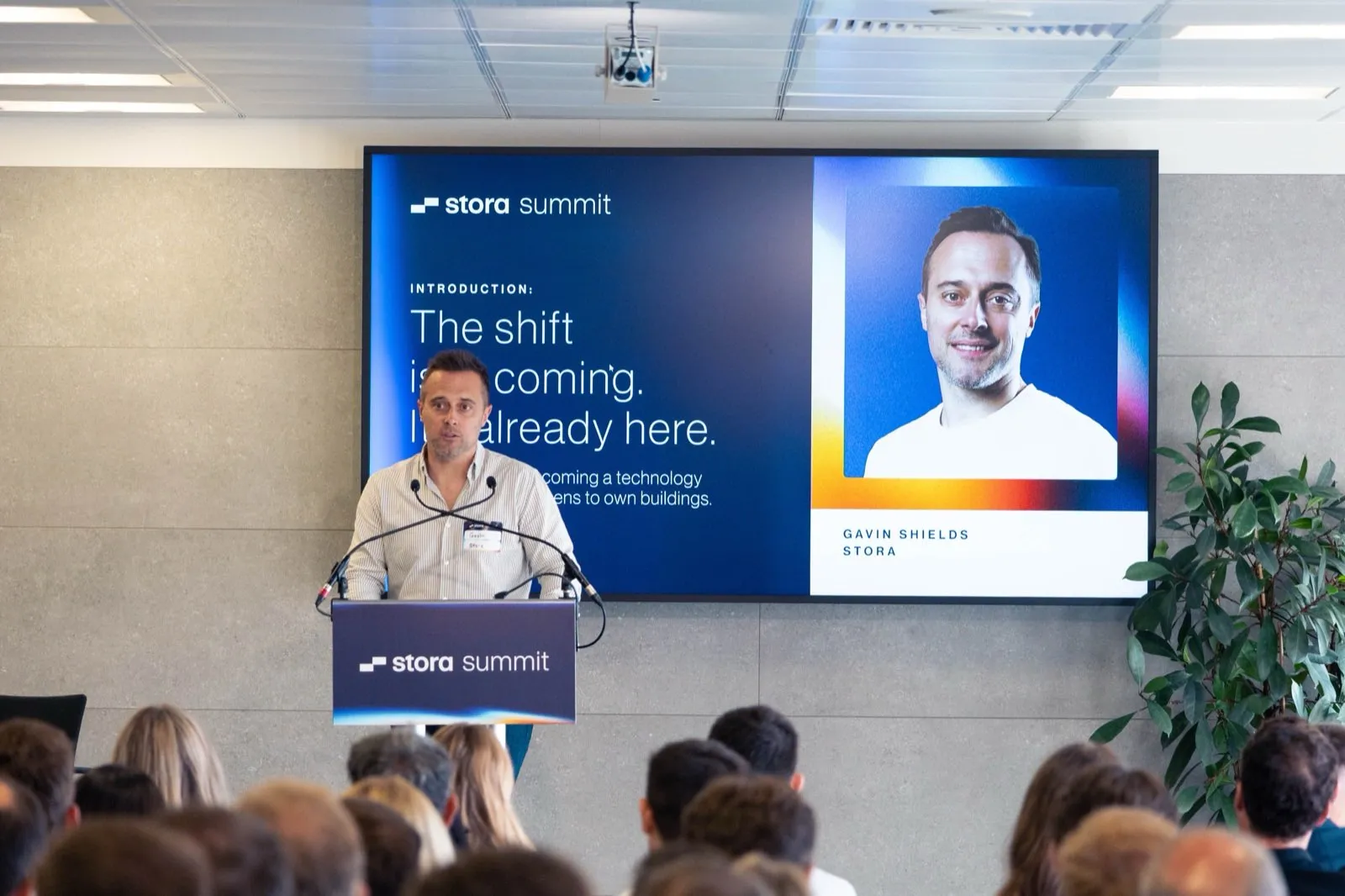
Gavin Shields
Stora

David Hughes
Stora
Key takeaways
- Two kinds of autonomy: autonomy of operations (things run themselves — voice agents, overnight pricing, self-chasing payments) and autonomy of choice (use the best tool for the job, not one vendor’s roadmap).
- Three shifts are hitting operators at once: how customers find you (agentic search), your business getting a brain (talk to your data), and how cheap software has become to build.
- Stora is built open, connected and AI-native. A public API and LLM-readable docs mean you can build an integration in an afternoon.
- The Stora App Marketplace launched at the summit, with live apps including Stashbee, KISS, Amix, Pentangle and Zapier.
- Gavin’s closing vision: walk in each morning to find overnight bookings, payments and move-ins already handled — your job is deciding the next site to buy.
Full transcript
This transcript is auto-generated, so it may contain errors.
David Hughes: So, we made it. We're in the last session. Thank you all for staying. And now I'm the one keeping you from the beer, but I'll try and keep this light. I'll try and keep this fun. And yes, so I'm David, for those of you who don't know me. I work in product at Stora, and Gavin's going to join me later to close the day out.
So today, I'm just going to talk about some of the things we've been working on, how we see things changing, and yeah, we're talking about autonomy. This word came up a lot today, and it's going to look like we maybe planned all the threads of the day, but we're not that organized. But autonomy has been a natural theme throughout the day.
Before we go any further into this section, I just want to be a bit more precise about what we mean, like Stora mean, when we talk about autonomy. So, like autonomous came up a lot in various different forms today, but it was mostly in the context of things running themselves, right? So, you know, the voice agent that answers the call, the pricing that adjusts overnight, the payment that chases itself, right? These are all autonomous things, things that you want your system and your software to do for you, and that's great. That's really important, and that's a huge part of it. But to us, that's autonomous operations, right? That's our bread and butter. That's what we do. That's why Stora exists.
So Gavin started the business to take all that manual, repetitive nonsense out of your day-to-day work. And that is interesting, but it's not as interesting as some of the stuff that we see coming in the future. And all that stuff has just become table stakes. Some of the examples today have been incredible. People building their own software, like everyone's a software developer now. That is insane. That is such an exciting time. Sorry, Aled, but like, it's really exciting, and it's just unbelievable that we're at this stage.
Where we see the next decade of software and storage software is, you know, it's more like choice, right? So this is another form of autonomy. Before, you were locked in, right? You used to be locked into one company's software, and you're waiting on one team's roadmap delivering all of the features that you need to run your business. That's not really the case anymore. Like today, people are building tools. Tools are integrating. And we see a future where, as a design principle, we believe you should be able to use the best tool for the job, right? The best in class, world class tool, whatever it needs to be.
So autonomous doesn't need to mean software that's just, you know, working for you. But it also means you're free to choose the tools and build the business that you want to build. And that's how we see the future. So, like I said, again, this came up. The amount of people building software that wouldn't have built software before is incredible. It's like software is changing faster than it ever has, and I don't think most of the world realizes the phase that we're in right now.
Like, I'm just about to turn 40, but I've lived through dotcom. Internet was young, but, you know, I've seen that shift, and I've seen the big shift in mobile. I think this AI shift that we're in now is bigger than any of it, by far, and I don't think anybody, most people, realize how big it is. It's faster than mobile. It's faster than dotcom internet, and everyone's a builder now. I think we're going to look back in 10 years and see this is such a formative time, but it's changing things that touch your business directly. And there's three things that we see that are changing that affect you, right.
So first thing is how your customers find you. So, like very recently, I decided to go to Turin at the very last minute. So I went to Turin for 24 hours, and I needed to fly there at short notice and be out sort of thing. And before, I would have had to look at Skyscanner or Google Flights and have 100 tabs open to plan this. But current me just asked an AI agent to do that for me. You know, find the best way to get there. I need to be there at this time. And it wasn't just the flight checker, it did the hotel, buses, trains, like everything. And I didn't browse anything. I just asked ChatGPT to figure this out for me, and it went and did it, and sent me a bunch of links. And that's, like, I know you all aren't daft. This is how people are going to find storage. It's already happening. Like, we see it. We've seen it. Gavin will talk a bit about this later, but it's about to be how someone sees and books. Like, it'll be, they'll just say, show me the cheapest storage within five miles where I can store the two bedroom apartment stuff, and it'll just come up.
The second thing is, and I talked a bit about this at the SSA UK conference, but it's the other side of it. We say your storage business is about to get a brain. That's just a fancy title, but understanding your business means, today, for the most part, reports and Excel spreadsheets and CSV and exports. But very soon, that's just a conversation, right? You're just going to connect that, and you're going to get the information that you need, and the answers. Like, who's overdue? Who's moving in today? Who's moving out today? You're just going to be able to do all of that. And your data stops being something you have to dig through, and something more like, you know, something you can have a conversation with.
And the third thing is, again, it's never been easier to build something. Building something and maintaining something are two different things, but it's never been easier. And what would have taken a team months to build a tool, you can now spin up in an evening or a weekend. And obviously, proceed with caution on that, but for the most part, it's much, much faster than it used to be. And yeah, building proof of concepts, little micro tools, it's here, and people are doing it.
So that's the weird thing. Like, what's not the weird thing. It's just the way it is. This has been an industry traditionally slow to move, right. Been pretty slow to move. And even today, in 2026, I'm still hearing, I'm jumping on sales calls sometimes just to listen in, and I'm hearing people deciding whether or not they're going to move to the cloud, right. And that's not even meant to be funny. That's legit. I'm hearing this conversation, and it came up today. And that's a big part of why this industry is stuck and has been slow to move. And that's not a dig at anyone either. It's just, moving things is hard. But that's the reality. Still a lot of big businesses deciding whether to do this or not. But the customers aren't waiting, you know. They're not waiting around. They're going to find storage from your competitors or somewhere else, and they're going to find things and buy things and book things where the people are, where they want to be. So it's moving faster than most of us can keep up with, but that is great. So yeah, there's going to be a big gap between ones that are kind of keeping pace, you know, people like you saw on the panel here, building tools and staying ahead of it. And then there's other people still deciding things that should have been decided, and that gap's only going to widen. Like I said, the pace of this shift is astronomical. So I guess the only question is, which side are you on? And that, I think, comes down to autonomy again, like which technology platform you choose, and where you want to grow.
So all the things we just described, you know, I'm obviously going to say this, I work at Stora, but we are built for this, right. Like customers find you through agents, you know, businesses answering questions like the guys on the panel did, all this because, you know, we have an API, and you get the information, it's public, and you don't have to worry about, you know, replicating all that information. It's all live. It's connected, and it's AI-native. So yeah, like none of this works in enclosed systems or old software. It just doesn't work. You'll be left behind, and what everybody needs, I think, is a platform built for this. And I believe that's what we are. But how do we make that possible? So yeah, these are the three things I talked about.
So first one: open. We have a public API, right. It's been six months old. We've made great strides, but we have public docs that you can read, but not only you can read, an LLM can read, right. So we talked about LLM-friendly documents and context earlier, but if the LLMs can read our API docs, and it's never been easier to build software, then guess what? You can build on Stora with this public Stora API. And also, the key thing about open is your data and your customers' data. It's open now. It's yours. You can act on it and do things, and that's what the agent examples are doing. So if a new tool appears or pops up, you know, it has somewhere to plug in, right. So that's kind of how we see it: open.
And then connected, obviously, goes without saying, cloud first, right. Everything can talk to everything. And that's an overgeneralization, but that's the goal, and that's, you know, where the agents come in as well, right.
And then the third thing is AI-native. So our platform is built so that AI can read your data, right. It can act on your behalf. You can point an AI tool at your Stora data and, you know, build a working integration in an afternoon. That's the goal that we set. And, you know, try that, try doing that on a system that is still deciding to move to the cloud.
But I think it's interesting just to reflect on how far the platform's come. Like, I've only been in Stora two years, and Stora, I might join two years ago. It was 12 people. Stora started as like four people, and five years ago, working on these things. But now we've evolved how we think about and work on these things as the industry's grown, and we've grown.
So something we don't usually do is, you know, I'm going to show you how our teams are structured. So our product engineering teams, this is how Stora is built today, right. Five years ago, it was five people in a room, or four or five people in a room. Now we have three teams, each working on like two or three projects each, and we broke it up into thematic areas to help own a layer of your business, right. So we have this operations layer, which is kind of bread and butter, day to day, you know, how you run your business. Again, all the automation that comes with that is by design. We also have the commerce team. So this is really all the money stuff, right. Anything storefront, payments, invoicing, all of that. That's our biggest product engineering team because it's the most complex. But now we also have this ecosystem team. So this is a new team. It's been spun up in Stora because of the shift that we see, and today I'm going to talk about some updates that we have from all three of these teams.
So yeah, we've got some updates on the operations side. If you're a Stora customer, this change is live in your account quietly now. You can go and play with it. But basically, now you can email all of your customers from Stora without leaving Stora, right. So you need to send a quick message. You can hit set a message, start emailing them. If you want to start from scratch, do that. If you want to pick a reusable template, you can do that. You can create as many templates as you want. We've redesigned the kind of, so our first iteration of the email sending thing, we will hold our hands up, wasn't good enough. This is way better and way more user friendly, and we know you're going to love it. So, easier, more user friendly, and yeah, customers get a preview, or you'll get a preview, of exactly what the customer's gonna get. And every message gets logged with a timeline. You also get open rates. So before, we said, was it delivered or not? Now you're gonna get open. Was the information, or was the email, opened or not? So this is live in your account now. This foundation is what makes the more interesting automation side of emails and messages way more interesting and possible down the line. So live in your Stora account, if you're a Stora user now, you can send emails from customer profile.
Was that video playing yet? I like that.
Another thing on the operation side. Aled, this is your baby, you worked on this. So yeah, move-ins that protect themselves. So basically, now customers' access won't be granted until they've met the move-in requirements, right. Whether they've signed the contract or done their ID check. So this all happens automatically. You don't have to manually intervene unless you choose to. And no, you know, no back office chasing. Customer get automated emails, and if you want to override the system and let them in early, you can do that. Again, this is examples of autonomy of operations kind of doing its job. And on the commerce side, we've kind of rebuilt subscription editing, which is a really fundamental part of the day-to-day. So at the minute, creating a subscription and editing it is a bit painful. We've rebuilt that, so you have full line edit control, cleaner tax handling, and kind of that foundational subscription related stuff is way easier and way more customer friendly, because they're not going to get multiple invoices per edit. So I think you'll enjoy that one too.
Which brings me to the third team, the new team, the ecosystem team. So talked about autonomy, choice. How do you deliver? How do you actually deliver on that? Like, for years, when you bought a software provider, you were locked in for years, and it was difficult to get out. We don't want that to be the case. So yeah, you picked the provider, and you lived inside what they built. And if you need a tool they didn't have, you just had to ask them for it, and wait, and hope. And up until now, that was the same for us too. Like people would ask us for things all the time. I'm sure we've all had a hundred feature requests. We've been down the back of the room. But yeah, waiting on other people's roadmap was a pain. And so six months ago, when we launched the API, we decided to try and stop trying to build everything, because we cannot build everything, nor should we. So yeah, we released the API about six months ago, and again, some amazing examples already, just from conversations and a panel of what customers are doing with it. But today, the ecosystem team is launching what we're calling the Stora App Marketplace. So for us, this is what we see. This is the first proper developer platform in self storage, and I think this is important now, because of where software is and how easy it is to build.
So this isn't just a list of integrations that we control. This is an ecosystem. This is integrations that everybody can use, right. And now, anybody in this room, with the Stora App Marketplace, any partner, anyone in this room, can build an app, submit it to the App Marketplace, and make it available to every single operator. No longer you're limited by what we're delivering, but your imagination. So, you know, not just what we build, but the best of what everybody can build. So this is live today, and we've already got some apps live on the App Marketplace. But I'm going to invite David from Stashbee up to show you what the first app that we put live looks like. This is one of the first integrations that are live on the App Marketplace, and it's live for everyone today. So rather than me tell you about Stashbee, I'm going to invite David from Stashbee up and let him tell you. David, round of applause for David.
David Mantle: Hi everyone. Yeah, my name is David. I'm the CEO and co-founder of Stashbee.
So what's Stashbee? Stashbee is a marketplace for storage. So we are the UK's largest marketplace for storage, and we find people who've got spare space, and we match them together with people who are looking to store stuff. We've been at this for quite some time. So we've got quite a lot of users now, and we've got 135,000 registered users, and we get 50,000 storage searches a month. And we've got millions of impressions across the internet. So we're actually a really great place to find new storage customers.
So over the years, we've actually worked with self storage operators, and we had feedback from self storage operators that it wasn't that easy to work with us. So about a year and a half ago, we got self storage operators into the room and said, you know, what is it from our product that you'd like to see? And this is really where Pipeline was born. So Pipeline quite simply is a demand generation tool for self storage operators. It's really simple. We find you customers, and we send them through specifically to your self storage site. And since we've launched it, we've had fantastic growth. So we've got about 15 percent of the self storage industry already using Pipeline, which is fantastic, and the performance of the product has also been great.
So since we've launched, we see about a 20 to 30 conversion rate of the inquiries that we get and send through to your storage sites. And I was actually speaking to Flexible Storage, David who's here today. He said this month he's had a 60 conversion rate of the inquiries through.
So we're all about finding really high quality storage customers and sending them through to your teams. But again, we had feedback from people who are using our service. The feedback was that, you know, I now have to manage this in Stashbee world where the inquiries come through, and also in my self storage software. And actually, this is a bit challenging. I'd rather it was just all centralized in one place. And that's where we were like, right, we probably need to think about integrating this. There's a common pain point that we're seeing across all operators. And so at that point we were like, right, well, who are we going to integrate with?
We started by asking our customers, and it turned out that 25 percent of our customers were already using Stora. And Stora being super, you know, forefront of tech and leaning into this for the storage industry, and the fact that you guys built the API, it just became a no-brainer. So yeah, we chose to integrate with Stora, and we've been working on that over the last three months. And yeah, really proud to say that we're now live in the Stora App Marketplace as an integration. So what does this actually mean? I think some of the key benefits are that you actually have the ability to now respond quicker to inquiries that come through from Stashbee. Also through that process, you actually get a higher conversion rate of the inquiries that come through. There's now lower admin. You're not having to copy the, you know, information from one system to the other, and really just a much more streamlined, better customer journey. But the truth of the matter is, it's much easier to actually see this in practice.
So this is the Stashbee dashboard, which is where all of your inquiries come through to. And as you can see here, this is where your inquiries come through, and we've built this tab here, which is called the integrations. And simply, you click on connect to Stora. You log into your Stora account. You click authorize, and that's it. Within two steps, you've now connected Stashbee to Stora. But what does that really mean in practice? That seems to have skipped on the video. So in practice, really what that means is that when someone comes through Stashbee, finds your storage site, makes an inquiry, they might click on get a quote, which then you have to complete, basically, your form capture: name, email address, etc., etc. Instead of that inquiry just landing in your email inbox, now we're fully integrated, and that means that actually a task will be created inside your Stora system, and also a contact will be created. And the idea behind that, meaning that it's super easy for you to now contact that customer and convert it into a paying storage customer.
So yeah, that's essentially the new integration that we've built. The video stops there, but that's the task coming through. And in here now, the contact information is there as well. So yeah, I think this is just a bit of a shout out really to Stora. We've done tons of integrations with lots of different industries, and honestly, the API is so easy. Like our lead developer said it was the best documentation he's worked with, and it was super easy, and the team were great. So if you're thinking of integrating with them, honestly, this is top-notch API.
But we're not going to stop there. We're going to actually take this a bit further. So we've got plans to go deeper with our integration with Stora. So next up, at the moment, it's pretty simple. You can only create a task and your contact going in there. We want to take this a step further and make it configurable, because everyone in this room uses Stora differently. So we will soon have the functionality where you can create a deal, and also potentially a prospect, and you can configure how you want to use Stora with Stashbee, essentially. And then eventually, we're going to also bring in conversion data as well. So essentially, when a customer comes through from Stashbee and actually converts in Stora, we will then be able to pull that information back and show you how many inquiries you've had, and also the conversion rate, etc. And then I think the next phase of it will be integrating, so we're pulling live information back into Stora. So things like what unit sizes do you have? How many available units do you have? What's the price point that you have currently, if you want to show and expose your pricing? Then you'd be able to expose it on Stashbee in real time, using your Stora data. Maybe you might have deals that you're offering, 50 off. All of that could be pulled through. But I think the end goal of where we want to get to is people can start their user journey, and you know, if they find your self storage site through Stashbee, they can actually book all the way through into your Stora platform. So that's the end goal of where we want to get to. So today, honestly, we have a lot of people in the room who are already using Stashbee. But we'd love to offer you two month free trial. So anyone who's here and wants to give it a go, two months free, can cancel anytime if you don't like it. We really only want to sort of offer this to people and keep people using it who are getting a good value out of it.
So yeah, please come find me afterwards. I'm going to be at the drinks, or drop me an email at [david@stashbee.com](mailto:david@stashbee.com). Thanks very much.
David Hughes: Thanks, mate. Thank you, David. David, you were way too kind about the API and stuff there. It was lovely. I'll buy you a pint.
But yes, so that's one of our first integrations live on the App Marketplace. We're very excited about this because of the possibilities. And this is what the Stashbee app looks like on the marketplace. So this is all live now at marketplace.stora.co. You want to check it out on your phone, do that. You want to check it out later, do that.
But this is, to me, an amazing example of a seamless integration. He showed how simple the user experience was for connecting. No developer needed. No nonsense. No API keys. We handle all that in the background with a nice handshake between the two applications. So yeah, a good integration that saves time, saves you time, and improves your day to day. And there's a couple of nice little details in there if you're a Stashbee customer and a Stora customer that I think you'll find useful as well. So yeah, that's live on the marketplace, and feel free to check it out.
But Stashbee are also in good company, with apps from different, all sorts, all sorts of different apps. Not just top of funnel kind of lead generation stuff here, right. If you can build on the API, if the endpoints exist in the API, for an idea that you have, your imagination is your only limitation. So yeah, we have other apps live in the marketplace today. So we have KISS. I'm sure some of you will be aware KISS, an NFC-powered smart lock and gate access system that syncs to Stora in real time. Usually, we would have had to build an integration like this with a smart entry provider ourselves in the past, and that's great because we have full control. But it meant that every time a smart entry provider came along, we had to reprioritize everything, kick our roadmap down the road, and that means you're getting less value sooner because we're working on something else. Now, smart entry provider can start that work and provide an integration that everybody can use. So that's live too. We also have Amax and Pentangle, both with self storage booking experience plugins. They're WordPress plugins. So basically, a booking flow that plugs directly into your WordPress site. No redirects. No handoffs. No new tabs. No developer needed. Really seamless experience. Again, you know, you connect the Stora app. If you have a WordPress site, you should explore those options. And yeah, of course, our existing Zapier integration is also live in the marketplace already.
So this is just the beginning. This is what's live today, with a lot more to come. So the AI agent topic's very hot right now. We have a whole category on the way for that, and I'm sure that won't slow down, because there seems to be more AI agents than I've had hot dinners. But behind it, it's not just the kind of surface level stuff, right.
Earlier, I made a claim saying this is the first proper developer experience in self storage, and this is one of the bits that makes that a true statement to me. We have a developer portal. So if you are a developer, and I know everyone in here is not a developer, but if you are, you can manage and submit apps. And you can manage them, and you know, upload the content, and submit these directly yourself without having to get in touch with us. So this is all open, all public. And earlier, we said the speed of building an integration has, you know, just dramatically decreased. Building software is better, cheaper, faster than it's ever been. Now, if everyone's a builder and this stuff's open, you know, who knows what you can build. So yeah, we're really excited about this. We can't wait to see what everybody builds with it. And yeah, to close out the day, I'm gonna pass back over to Gavin to kind of wrap up. But yeah, thank you all, and we'll see you for drinks. Really excited about the marketplace.
Gavin Shields: Okay, thanks, David. I know it's getting late, and there's a bar waiting, so we will wrap us up in the next 10 or so minutes.
So, I suppose I just wanted to close this up, finish off what David's saying, with just to kind of say, like, here's where we see this is going. The way people find things and run things is changing. We've been talking about that quite a bit today, about even just finding things through, you know, ChatGPT, LLMs, and your customers are more and more gonna be booking storage by asking an agent. You know, that's happening.
Even like an example of myself at home. I have hedges in my garden that have been dying for a year or two, nothing great ship, and I took pictures of it about six months ago. Asked Claude, like, what can I do about this? Claude sent me a bunch of advice for what to do, and then I said, well, what do I need to buy? And it sent me links to these special hoses and all these different things that I have no clue how to do. This stuff, I've never done it before. I'm terrible at it.
But I just clicked on those links, went and bought them, and then they arrived in the post. I said, oh, they're here. How do I connect this hose to this? And took a picture. It replied, it took me through step by step how to do the whole thing, and I just bought what it told me to buy. Like, I didn't go searching Google for the same, you know, the alternatives. I just said, okay, you told me to buy that, I'm buying it.
So, like, I'm finding that in my life. I think, you know, we're seeing it a little bit more in the data coming through Stora. We're seeing it's happening with the bookings coming through. But, you know, this is the way the industry is going.
In fact, we had a customer. A customer called us a while ago. If any Stora customers here, you may have had a test site before you went live at Stora. We had a customer who had a test site, and somehow or other, somebody found his test site through ChatGPT, landed on it, and placed a booking. This person turned up at his site with his stuff, but actually had not made a booking. But we can't figure out how you did it, because you can only use test cards. Anyway, so people are already finding storage, even accidentally, in the UK.
So, you know, it's happening. So this is the way we see things going. We think, you know, we want to help, you know, you have more around your operations that run itself. So autonomy of operations. We want to help you do that. It gives you more that's yours to control.
So also moving you towards autonomy of choice. So giving you more choice of what to do, how to run your business.
So, autonomy of operations running itself so you can run your business. So that’s a little kind of an idea of, in the future, just picture this morning, not far from now, overnight your system's handled all their bookings, chased payments, closed all the move-ins. You walk in and all the busy work's done, and the operations really are running itself. All you need to do is think about what the next site is you want to buy.
And then, from the point of view of giving you autonomy of choice and giving you more choice, we think there's a massive, you know, a massive opportunity here to give self-sorge operators much more choice here. So another example is, you know, building a report. You know, maybe at the moment you might need a report, and you might ask us, and we think, okay, well, we'll see when we can build it. But there's no reason that that's not the sort of thing you could do yourself now with the right tools and with our product as well.
So this is how we see things going. We think the app marketplace is really a really big step forward here in the industry. It's great to have had David here from Stashbee to sort of bring it to life as well, but, you know, hopefully over the next year or two this will grow and give you more and more options of what you can do over time.
Okay, so I think I'm gonna kind of finish up now. Just before, just all at all done, I've got, you're trying to avoid this, Aled.
At the start, Aled asked, or I think you said, you know, if you don't know who I am. But Aled actually has a background in acting and used to do Welsh language children's television. And so, whenever we were trying to figure out who's going to host this event, the reason we chose Aled, apart from his dashing good looks, was that we found this video online as well.
Oh, sorry. Go back. This is where to go. A bit of sadness. This is where to go if you want to check out our developer marketplace, but I just can't wait to show this video.
So this is Aled video. We found this of Aled online, and it happened to be in front of containers. Do we have any sound or no sound? It's in Welsh. I don't know what's happened to sound. Maybe we cut out the Welsh. This is the best bit coming up now.
But I did want to say a massive, massive thank you to Aled. It's been brilliant. So thanks very much. I also just wanted to quickly also thank Manuel, who I think is probably outside. He has pulled this together in a really short time. He only joined a few months, like four or five months ago, and he's been given this task. I don't know if he'll hear this, but massive thanks to Manuel as well.
And thanks everyone for coming along. It's been really great to have you all. I see, like, Steven from the SSA. Thank you for coming. It's great to have you. And Paola, I think I saw her from FEDESSA. If you haven't a chance to chat any of those guys, go and chat. If you're not really members, it's great to have them along.
Yeah, and thanks everyone. I'm sure you're also sick of the sound of my voice, but next step is Clays. Maybe you'll talk about it. There is an open bar, though, and, Fernal from PTI, I have phoned ahead to tell them you're coming, so they're ready for this open bar. There is enough drink, even if you're involved.
So, yeah, thanks everybody.
Aled Bidder: Thanks, Gavin, and thanks, David. And thanks also to David for putting my name on the booking feature, so now next year's Summit, you know exactly who to track down if anything goes wrong with that feature. I told you that's how it works.
So yeah, that's the first ever Stora Summer. Gavin's just thanked everyone, but I'm just gonna thank again, you know, every one of our speakers and partners, to the Stora team who pulled us together, and most of all to all of you for spending the day with us.
The point is, today was never to talk about software or companies. It was to get people who actually care about the future of the industry in one room and have the conversations that move the whole industry forward. So thank you so much for coming.
Two quick things before we go. One, you'll see a QR code on the screen here. This is just for a really quick survey, 60 seconds. We really appreciate if you could do it because it generally shapes what we do for future events.
And yeah, tonight, the evening kicks off at 6PM at Clays. So not long now. Food, clay pigeon shooting, an open bar. What could go wrong? Bring your wristband. You'll need it to get in, and if you don't have one, if you need to buy one, please speak to us and we'll sort you out.
So yeah, on behalf of everyone at Stora, thank you for being part of the first one. Travel safely, and we'll see you at Clays. Thanks so much. [Applause]