
What does best-in-class look like in 2026?
Operators running businesses at different scales unpack growth, pricing, automation and the reality of scaling across multiple sites.
Ponentes

Mark Drummond
Now Storage

Matthieu Burnand
Bien Sûr
Ann-Kristin Hartmann
Spectrum Storage Group
Key takeaways
- Growth levers differ by operator: outside capital and flexible leaseholds (Bien Sûr), 17 years of own capital and freehold quality (Now Storage), or acquiring stabilised, cash-flowing sites (Spectrum).
- Pricing splits on gated versus published. Bien Sûr publishes prices — cutting them 20% in one market tripled sales. UK operators tend to gate; the Nordics expect instant online pricing.
- Online booking and access control are the base automation wins. AI is used mostly for analytics, chasing late payments, and clearly-labelled phone and chat agents.
- Centralise pricing and process; keep sales and customer service close to the customer. People and trust matter as much as systems.
“People are your best brand ambassadors. They can make or break the business.” — Ann-Kristin Hartmann, Spectrum Storage Group
Full transcript
This transcript is auto-generated, so it may contain errors.
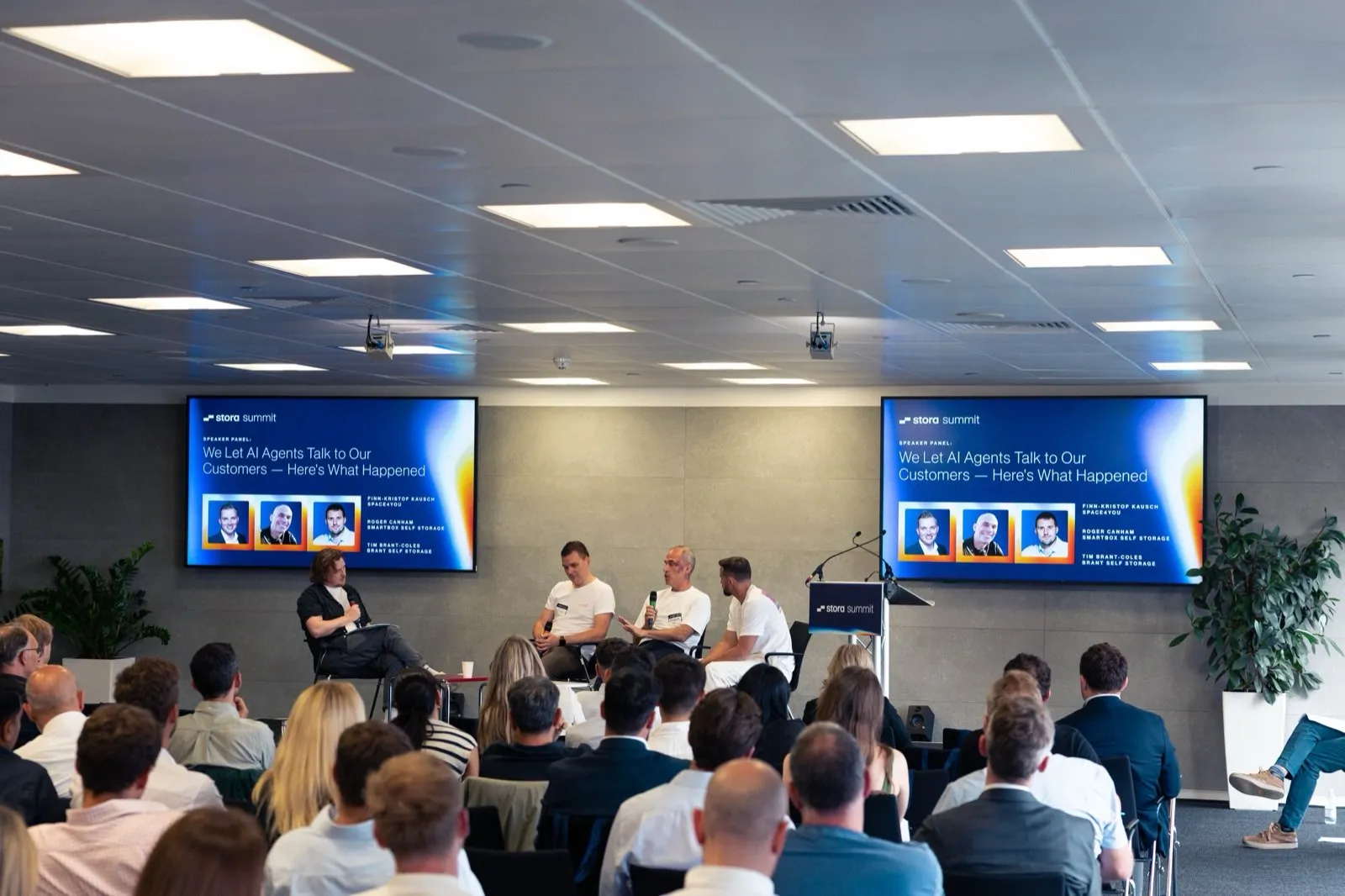
Aled Bidder: Next up is a panel discussion on what best in class looks like in self storage in 2026. I'm pleased to introduce our chair for this panel, Graham Lomax, Head of Strategic Sales at Janus International, who has worked with hundreds of operators and sites for nearly 20 years. Please put your hands together for Graham.
And quickly, just our panelists as well. First, Matthieu Burnand from Bien Sûr, one of our very first customers who has grown with us from a single site to now three sites since joining and has helped shape the platform with consistently thoughtful feedback along the way. Mark Drummond from Now Storage, one of our newer customers and a well-known UK storage brand with 16 sites across the country and growing and 19. Finally, Ann-Kristin Hartman, CEO of Spectrum Storage Group, which includes Storebox, one of the UK's Top 10 self storage operators and LOVESPACE the UK's leading by-the-box storage business.
Graham Lomax: Thank you. Thank you very much. This session, what we're looking at is what does best in class look like in 2026. Obviously, we've got three very different businesses that are going to be speaking for us, giving us different ideas as they run their businesses very differently. They're unpacking growth in a completely different way. How do they deal with pricing? I think that's going to be quite interesting from some of the questions we've already had.
The reality of scaling across multiple sites, the point of difference generally is the contrast, and we've got three very different growth models, different geographies, and all three businesses are at very different stages of maturity. So the same question is probably going to produce three completely different but legitimate answers.
Panel, if I could probably ask you to actually introduce yourselves first, if that's okay. If you can start with Matthieu.
Matthieu Burnand: Hi everyone. I'm Matt, the founder of Bien Sûr. We're a Paris-based self storage operator. I created the company maybe five years ago, and now we have free facilities in the Paris suburbs, so close to Versailles, for about 1,500 units in total.
Mark Drummond: Hi everyone. I'm Mark Drummond. I, with my brother Guy, run Now Self Storage. We started in 2009. We bought two shipping containers and gave it a go, and now operating over 19 locations, sort of over the southeast of England, West Midlands and Wales.
Ann-Kristin Hartmann: My name is Ann-Kristin. I'm the Group CEO of Spectrum Storage Group. So Spectrum Storage Group is the combination of Storebox Self Storage, traditional self storage, and LOVESPACE, which is a tech and logistics space business. They've been operating individually since 2009-2011, but they merged together to form Spectrum Storage Group in 2024. So we have, in Storebox we have 6,000 units, roughly, counting and sort of adding every day, building out, just over 580,000 square feet of units. And in LOVESPACE we have 35 warehouses, warehouse partners across the UK, and just over 100 vans out on roads every day now, collecting thousands of boxes.
Graham Lomax: Excellent, thank you. So we can see we've got three very different types of businesses. I think what we would like to try and look at is if we can talk a little bit about what growth looks like, the difference in pricing, automation technology, and then what multi-sites scaling and operations actually looks like for each type of business. So if we start with growth, if I start with yourself, you've gone from a single site to three across France. It's a pretty short period of time for an independent. Obviously you've picked up a French SSA award. Congratulations for that. Take us through what growth is for you. What's allowed you to move so fast as an independent? What would you tell someone that's trying to do the same or any advice you could give them?
Matthieu Burnand: Okay, well, I guess we were able to go fast partly because we had access to capital. Capital is obviously a big constraint in our industry, especially when you're starting off. So I was lucky to have worked or to know some people who were willing to invest in us. That was a big one. And then I think we're maybe, we try to be quite flexible on what kind of, let's say, real estate we could, we would use. I guess that's another big bottleneck in self storage is finding the right real estate, especially in dense places like Paris and suburbs where land is scarce.
So actually, three of our facilities are leaseholds. That also reduced the need for capital and also made it easier to find real estate. And it happens that in France, we like regulation a lot. And so actually leases are very protective of tenants a lot more so than they are here. So actually, for example, nine-year leases, but we're actually very protective of tenants a lot more than you would here. And then I'd say also that people matter a ton. I mean, I was lucky to meet so many people who were helpful and who were nice and who knew self storage well. And that saved me from making so many mistakes. So yeah, that was a huge accelerator too.
Graham Lomax: Excellent. Mark, obviously you're an established independent, 16 sites. Where's the growth now for yourselves? New sites? Are you continuing that growth or are you concentrating more now on trying to build sort of ancillary revenue?
Mark Drummond: Yeah, I think it's an interesting question. I think actually our story is probably very similar to Matt's really of how we started. So we started leasing sites to traditionally do container storage, which served us really, really well. And I think probably hitting some of those towns where you wouldn't necessarily see some of those national operators. And that strategy is still very much part of our growth. We've also moved into operating some indoor sites. We've got four indoor locations now, sorry, three. That's probably about five years into that. So we still see some growth in that sector as well.
But I think growing the business through sites, taking on new storage businesses and starting from the beginning is probably what I'd say growth still looks like to us. And pretty challenging. There's a lot of competitive markets out there. So we're deploying our own capital. So we've taken 17 years to sort of get into the position we are. So we're just trying to go for really good quality. So that might be freehold stuff, certainly with the buildings and just really trying to get those fundamentals correct. So great quality assets is what we're after.
Graham Lomax: That was going to be a question talking about the capital, because if you've got leasehold properties, raising capital for leasehold, have you found that more difficult, but you said that you're actually using your own capital?
Mark Drummond: Yeah, no, it's the fruits of 17 years of operation. I think it's a bit of a cliché, but broadly true is that the storage isn't going to make you rich in the short term, but it will reward you in the long-term. And we're in it for the long term and we're trying to make decisions based on long-term wins.
Graham Lomax: And, Ann-Kristin, obviously Spectrum has grown largely by merging acquisitions. So how do you choose between building, buying, or complete portfolios or purchasing individual providers?
Ann-Kristin Hartmann: That's a great question. Yes, we've grown a lot. So over the last two years, we've grown by taking on 14 additional sites, around 300,000 square feet from those acquisitions alone. We bought one of the biggest operators in Northeast, MyLockUp, and integrated that. I don't think it's a secret that our strategy is mainly to buy either single sites or multi-site operators. We believe it's worth paying more to buy a multi-site operator as well, mainly looking at what we're looking at criteria as buying stabilized assets with a cash flow generation coming from that.
Graham Lomax: Excellent. If we can lead on to note the pricing side, obviously, there's been a couple of questions on pricing already. If I can start with Matthieu, how sophisticated is your pricing model today?
Matthieu Burnand: It's not as complicated as I'd like to pretend it is. We've learned yield management does really work. And I think we've also noticed that some facilities are more or less subject to active yield management. I know for example, Shurgard, I think they change their prices almost every week for every single facility. We're not there yet. We'd like to get there, but that actually requires just so much data. Yeah, just very, very difficult to put in place. But we have noticed on some facilities, especially where there's a lot of close-buy competitions, then indeed the demand is very dependent on your pricing. Actually, just a few weeks ago, we maybe reduced our prices by 20%, and I think our sales tripled. That's maybe our most competitive market. Whereas we have another facility that's a little less competitive, so less competition around. And there, when we change prices, it doesn't really impact reservations that much. So we learned it really depends on how much competition there is around. I guess if it's an oversupplied or undersupplied market, and also just how I guess wealthy the local population is.
Graham Lomax: Are you publishing your pricing?
Matthieu Burnand: Yeah, they're all online.
Graham Lomax: So with your sales dynamic pricing, it's a manual dynamic model?
Matthieu Burnand: For now, yes. Very analytical, but yes manual for now.
Graham Lomax: Excellent. And for you Mark?
Mark Drummond: Really, really similar. We’re gating pricing. We've got the ability to display pricing on a website, but I think yeah, it's a...
Graham Lomax: So you've got the ability to, does that mean you don't...?
Mark Drummond: We don't do it, but we could do it. We've trialled it a little bit, but I think it's a really interesting thing, a great question earlier on about should we display prices and should we discount? And I'm... What we've done predominantly for the last 10 years, I'd say, is gate the price, and where we need to, we are discounting. We're not using dynamic pricing as in changing our prices that often. We're using... We use StorTrack to track competitive pricing, and there's 100% a factor in what we're trying to do, but I think it's really... It's sort of underwriting process of when you find a deal and you're looking at the price you think you want to charge, that sort of element never stops. You need to be looking at what your competition is charging, because ultimately, that is a massive deciding factor, and we're optimizing for long-term customers. I think if we were to... I just would have thought there's probably like 30, 40% of our units that don't have a discount on at the moment, and they would be... They'd just be in that higher occupancy class, but predominantly customers are just getting a discount on the way in. Now, I think we are giving away margin, but I think one thing that everybody needs to look at carefully is their average length of stays of a move out, and that can differ massively on the time of year that you require a customer and on the location. And that's very difficult to gauge that before you take on a site, but I think at the moment in our student towns, average length of stay for a move in, it could be as low as three months. If you're discounting at 50%, then you've got to make sure that you're happy with what you're going to make in three months. So there's a big argument for small units in student towns that we're not discounting on those and we're willing to walk away from customers if we don't feel that we're going to make the correct margin out.
Graham Lomax: It's interesting, because I think on Andrew's slides before, he was talking about dynamic pricing, and I think the first three things he said was local, seasonal, and event-driven, which is exactly what you're saying there. We've got your discounted.
Mark Drummond: Yeah, 100%. Which I try to keep things simple, I think 100% that when it makes sense that we'll move to systems like Prorize and let it dictate its pricing, but I'm still sort of setting prices on a weekly, bi-weekly basis. And if you get it wrong, if you're keeping, if you're out of the bidding on being competitive, then you can see sales drop quite quickly.
Graham Lomax: Ann?
Ann-Kristin Hartmann: Yeah, so we use dynamic pricing. It's still a fairly manual process for us, but we also like having the ability to make those assumptions around certain sites based on performance or competitors showing up and things going on in the area. We obviously price very different products. We price our storage units. We price our buy-the-box products in LOVESPACE, and they're all available to all customers. So we really try and navigate the customer to see what kind of product or what kind of service is right for them, so that they're not ending up getting confused or comparing the prices across the product groups.
Yeah, we have prices online, but they're behind an info wall, they're gated. And coming from the Nordics, that's actually, because I'm from Norway, that is a very different scenario. I think if you did that in the Nordics, people would not like it. We're very used to getting prices instantly and finding the prices that you need online, being able to compare. But actually, we saw in the UK, we've trialled both, and we saw that we were losing out on a lot of leads, and people were not converting right away necessarily, so we had to work on those leads further in order to convert them. So that's the best strategy for now, but it's hugely driven by larger operators naturally choosing to do that. So yeah, I'm feel confident that maybe we'll see a change in the future.
Graham Lomax: So you think you'll probably have your pricing ungated if others do the same?
Ann-Kristin Hartmann: I think yes, because there's so much competition. I say we trial both, and our conversion dropped when we had the prices visible online. So you need to be aware, and you need to try and stay competitive as well, actually. But mainly, you need to get the data, you need to get the details. And say the Nordics is very different, the bookings will convert right away. There's no leads that really follow up in the same sense.
Graham Lomax: I think it's very interesting because picking up one of Andrew's points, wherever he's gone. Sorry if I misquote, Andrew, but I think one of the things you said was, which I've really quite liked, once price and availability are visible to all, confidence and convenience decide. I think that's possibly a really good point of how our industry can move forward. But as you say, take someone to start, and then everybody to follow.
Ann-Kristin Hartmann: I think it's very specifically for the UK compared to what about a scene in other markets.
Graham Lomax: I think most of us are very similar, but if you go online, you want to buy something. I don't know how much it costs.
Ann-Kristin Hartmann: The sales storage industry is very similar. We just need to make sure you have the best product to sell.
Graham Lomax: Definitely. If we could just move on to talk about the automation and technology that you're using. Where would you say that automation has generally moved the needle for your businesses? Where has it obviously worked, but also really importantly, where is it disappointed? Or where do you think, what do we need to make it better? We’ll start with you.
Ann-Kristin Hartmann: I think if we just go back to basics, obviously having online bookings is a huge part of automation. It allows the customers to book online, gain access right away. There's no paper trail or anything you need to sign or fill out. Access control, of course, is another thing. I think for us, when we first started having online bookings, which is five years ago now, that was a game changer naturally. I think where we've seen challenges maybe is that with access control, for example, we have some gates that are still on older keypads with Maglocks. There is no advanced technology necessarily and nothing to break. It's stable. It works 99.9% of the time, otherwise you have integrations, you have APIs and all these things to consider and things do break.
Graham Lomax: You've seen a big difference because obviously you've got a lot of experience from the Nordics, that compared to say the UK and Ireland.
Ann-Kristin Hartmann: For automation and technology? I think the Nordics are quite far ahead when it comes to technology, self-serve, automation, all these things for the customers. I don't know if there are huge differences. I was asked the same question in a webinar actually. I'm struggling to find some of the differences. Some customer markets are further ahead than others, especially when it comes to self-serve. Yeah, and demand.
Mark Drummond: I think the big wins that we probably had have been, as a business owner, you put yourself in the ability to remove all those frictions for the customer. I think one of the slides from the last talk was great on it. That’s sort of our job, it’s to make sure that that customer gets to the point they want too quickly. We're about to go live with online booking in the next few months. Not something we have done. Really looking forward to that. I think what I get excited about would be is the idea of all of our tech stack really communicating properly with itself. We're not manually inputting data. Website comes from our website. That's ultimately being populated where it should be. We're using softphone systems and all those kind of things to really have our staff focused on the job in hand.
Things that have disappointed me. I think not loads of things. We're always thinking about padlocks and access control. We're just trying to keep things really, really simple. We're not trying to reinvent the wheel always. Sometimes less things are better, I'd say.
Graham Lomax: You're implementing, as you say, different tech stacks within the business. At the moment, is that actually benefiting you or is it actually creating more work for your existing staff to manage these systems? You'd say you'd like to see something that can take over and monitor everything together. Is that an issue for you for the business?
Mark Drummond: We're using HubSpot CRM, which is where we're managing our customer, managing and communicating with the customer from. What it gives you is, it just gives you a lot of data on what's actually happening in your sales process. If we were to take that away, it just wouldn't work as well. I think our staff love using it. I think that's, a big consideration is actually what the staff like engaging and using and the customer as well. That's really important. Customers are going to expect this. We've got to move with the times.
Graham Lomax: You're doing it, is it customer driven or is there also an element of can it do what staff would do?
Mark Drummond: Yeah, I would say, I think it's interesting when you read people's reviews, read your, read your competitors reviews. What's that actually saying? We don't get lots of reviews saying, "Oh, the online booking process wasn't great or anything like that." We're still quite manual in the sense that we're talking people through. What customers actually like is still interacting with our staff. That tends to be what we get the best feedback from. We're not trying to remove that element of us being available to customers to talk to.
Ultimately, probably things like Aircall, we use, yeah, mainly Aircall is what we're using to call customers on. That is driven more by us. There's no real difference for the customer and what phone system we use. There's no compromise. We're trying to make decisions that are good for business, but not definitely not compromising with the customer.
Graham Lomax: The same for you, Matt. Obviously, with a smaller operation, are you finding the same issues?
Matthieu Burnand: Yeah, well, I think definitely automation does help reduce customer friction. I guess that's what we've said. I really believe that sales staff should be spending the most of their time selling as opposed to taking care of admin, like filling out contracts. I was quite shocked when maybe even just four years ago, I think I rented a storage unit for myself at the largest operator in France. They have 100 facilities and to sign the contract, they physically printed it out. Then they highlighted stuff in yellow. Then I spent some time reading it, signing it. Then they had to go back and scan it. Then they, I just couldn't believe it. Then someone has to go and store that contract. So why some archive system? We're now completely paperless. We don't even have a single archive. We don't even have printers in our warehouses. That saves just so much time. Customers again can book remotely. They can book in-store. I think automation helps with convenience. Hence, with the revenue side, but also it can help a lot on the cost side.
By now, a lot of our handling late payments is a common issue in self storage. It's just very time consuming. The more we can automate that, the less well, I guess the benefit is, well, you, there are less mistakes that are made. We have automatic emails that are sent. Now we can even send automatic SMS messages, even registered mail. We have multiple steps depending on how late someone is. It avoids people forgetting. Also, late payments is quite a, well, it's not the thing that staff enjoys the most. If you can automate a good amount of it, then that also takes, I guess, your staff slightly happier. Of course, there's still the manual part, so you still need to call from time to time.
Then I'd say that the last part of automation, because all this is, let's say, digital automation. I think one of the hardest things is also, well, self storage, it's still a business that's in the physical world. I think one of the toughest things is automating the physical world. A bit like doing that gates that can instill sometimes not work. I know users that will use it in an unexpected way and break it down. Also, I think you will try to automate as much the physical side of things and also being able to pilot as much as possible. Because sometimes I know we have gates that just stop working and you just need to go to facility and switch a press button and then it just works. But if that happens like a Saturday at 10PM and you have to send a staff member there, it's, well, we're not too happy. Now, I mean, we've actually, there's a lot of this, but now we can do fully remotely. So if something breaks down, you just click a button on my phone a minute and then just react to it. And that I think actually is pretty powerful too to help bring down costs.
Graham Lomax: Excellent. And then obviously, keeping with automation technology, you know, are you implementing much in the way of AI? Or is there, if you could have something tomorrow that maybe is not available today, what would it be? Mark?
Mark Drummond: Yeah, obviously, we're using AI, sort of, in the ways other customers are. But yeah, it's a great sort of aggregator of data and helping us understand some of those things that we were talking earlier about, average length of stay. And great at getting through large amounts of data. I think last year, we engaged with a statistician about average length of stay, which was probably two or three days work. That now is taking 20 minutes of work now. So I think the danger can be that as a business owner, you've got lots to look at. And I always like fiddling with things, fiddling with prices. And it can be quite overwhelming, the amounts of information that we sort of have access to now. So again, going back to original point, trying to keep things simple. But it's great for the members of the team as well, doing deal notes. And when a customer's calling us and that we've already spoken to them last week, last year, that that information is in our fingertips. And as Matt said, allowing members of the team, members of staff to sell and engage with the customer. The talk earlier about Screwfix and their coupons and their letter, when you answer the customer with their name, and that you know what they're talking about, that goes a hell of a long way, just to bring a bit of sort of personality to it.
Graham Lomax: And what about yourself?
Ann-Kristin Hartmann: So we use AI mainly for analytics as well, analyzing large amounts of data, especially within finance as well, to analyze revenue numbers, etc. We've also introduced an AI agent on our phones and chats, mainly as a trial within LOVESPACE, but also rolling it out to StoreBox soon, which will help, and especially assisting the team when it's busy. We're not trying to replace the team, but we're trying to help them and obviously deliver the best possible customer service by customers having the answers they need and want right away. If we could automate something, I think there are already so many great solutions for us. The next step is probably automating our dynamic pricing module. Our price increases as well. And there are solutions, but we're still on the hunt for the perfect one.
Graham Lomax: When you look at it, let's have the front end of the business. Are you making it obvious to the customers they're talking with AI? Or is it just being introduced as well as?
Ann-Kristin Hartmann: No, so when you call and you speak to an AI agent, it will make it very clear that this is an AI agent and the same in emails as well, making it clear that this is an AI-generated response. So our next sort of step is to connect that to our live orders, all of our systems so that it can help instantaneously.
Graham Lomax: So you've got a fully integrated system that can go from end-to-end?
Ann-Kristin Hartmann: Yes, well, that's the dream. Almost, that’s the plan. Thank you.
Graham Lomax: If we want to just move on a little bit to talk about multi-site scaling and operations, if I start with yourself, Ann, what do you tend to find? What breaks first from having a handful of sites to go into 29 now? Is it people, systems, trying to keep brand consistency? What have been the challenges with that sort of size growth?
Ann-Kristin Hartmann: Yeah, so I think when you're scaling either way and especially when you're integrating businesses you've acquired as well, the pressure on all of the systems, the people, the brand, the systems, the process you have, it all becomes very visible when you're trying to integrate something based on the scale you're integrating in as well and how many sites. We focus on all of them of course, but we tend to focus as well very much on our people and I believe that people are your best brand ambassadors. They can sell your product, they can make or break the business essentially. So we focus a lot and invest in our people and their development as well.
On a brand consistency, it's always challenging to integrate any brand or to change a brand. Definitely, we usually have a period of time where we assess the local brand awareness so that we can assess what impact it has in the local community, search volumes, all those things as well before we start.
Graham Lomax: So you wouldn't automatically flip from taking on another brand, you may continue that brand for some period of time?
Ann-Kristin Hartmann: Yes, definitely, while assessing. As I say, the power of the brand can be quite strong in any local community and depending on what a business has done with that local brand as well, it can have huge value.
Graham Lomax: You didn't implement what your operating process is as fast as possible I guess, or you're still operating on different platforms for different brands?
Ann-Kristin Hartmann: No, as soon as possible we will integrate them into our existing platforms. We will also, the first thing we focus on is making any location self-serve, automated so that you can book online and you can easily get access to the information the prices are.
Graham Lomax: Is that fairly easy to do? You know trying to bring everything into the same platform or you have to completely swap or are you using like an independent?
Ann-Kristin Hartmann: It depends I would say on the platform and what we're trying to integrate. We do have a very good tech team in-house that handles a lot of the integration, the website. So we can, I would say we can be online website-wise fairly quickly as quick as we want to and then for the systems we always know is a bit more challenging. There are different size codes, different prices, different rack rates you will try to integrate in the same platform.
Graham Lomax: And if I can jump to yourself Matt, so obviously with three are you looking initially as soon as you start a new site standardisation, is that really important to you? Or are you still trying to look at, you know, is it site specific in a region?
Matthieu Burnand: Yeah well that's a tough question because you need very certain functions you want to centralise so to have that's a benefit to scale and some that you want to decentralise. And it's true at least we actually try to decentralise quite a bit all customer service and sales. I think eventually that will change. I mean there are obvious things that you centralise such as pricing, I guess your processes. But actually yeah I guess this is a big debate in any industry, what do you centralise, what you don't. And also I think there's a question of it's true also it comes back to automation, the more you can automate the more you can centralise. Then I know for example in France there's still a lot of people do cool, I think we're talking about automation and online bookings and we let people book online but only a quarter of our customers book online although it's super easy to do so. Free quarters still have questions and will usually reach out to us before they book. Again that's probably very different to the Nordics where it's probably two thirds, three quarters of people that book online without any questions. But yeah so we're still figuring key decentralisation versus centralisation.
Graham Lomax: Obviously you're building your brand and your portfolio, when you're making these decisions are you thinking, I'm going to have 20 so I'm setting this up so that when we've got 20 we've got this standardisation or are you looking at, here's a new store we're adding it to what we've already got.
Matthieu Burnand: Well you definitely go step by step we're not yet thinking about 20, well now we're free we're maybe thinking more about how we get to five or four. But yes at least our proceeds are pretty set then I think also to what Ann-Kristin was saying it's also about finding the right people as well because even if you have an amazing system and you have bad people your system won't be in place. So again one of the things that's getting good people who don't need that much of an oversight. I guess just, trust is key in any business and what have people you can trust.
Graham Lomax: And it's obviously the same for yourself Mark, obviously with the amount of sites that you've got have you had to change your systems as you've grown or did you particularly look at this is where we want to be and you've worked towards that goal?
Mark Drummond: You want to know what's gone wrong, do you Graham? I think we set out early on with sort of like the centralized system of having one sales team based in one place and I think that's obviously a great efficiency. If you look at the industry reports about how many members of staff per store obviously that's falling. I'd say if you look at on a square footage basis we're very efficient but what you sort of lose, then, would be over time is that that nature of that when we first started out that we probably knew lots of our customers personally and our understanding of all that was going right and wrong on that location was very personal. When you scale then you lose that. So a member of the team could be speaking about a shipping container with someone in here for one minute and they put down the phone and they're then talking about a first floor 25 square foot unit in a building in Basingstoke or something and that's quite a challenge. So you need very robust processes in place to make sure that you're sort of trying to do the best job you can.
When we've started opening our buildings we've reversed slightly and we're actually putting members of the team into buildings now, mainly because we've got a lot at stake. We've got to make it successful and we've got to still have people in the business and I think that's just born out by the idea that we want to bring back a little bit more of that personal touch, that we're not a completely sort of faceless business based a few hours away that there is actually somebody there. And I suppose that there's not, I just don't think there's probably many examples of large indoor operations with 50,000 square foot that are completely you know, centrally managed. It is tricky so that's why we're sort of putting people back into our indoor stores.
Graham Lomax: Obviously, now we started saying that the question is what does best in class look like. And I'm going to guess best in class looks different to each of you based on where you are in the business's development but starting yourself now. So for you if you have one sentence to say what does best in class look like for you?
Matthieu Burnand: One sentence.
Graham Lomax: Maybe two.
Matthieu Burnand: I think best in class comes down to understanding what your customer wants a bit on what our previous speaker was talking about. You've got to understand what they want, what their expectations are. So they won't tell you all their expectations, some are implicit so you need to understand those.
Graham Lomax: But for yourself, is best in class, you consider what's best in class for me or are you thinking I want to be best in class, much my competition?
Matthieu Burnand: Well I guess in the end best in class is winning customers.
Mark Drummond: Yeah I think it's a tough question. I think best in class is really to think of some of those big brands that are out there that are very well trusted and recognised and doing a great job. And I think there's loads of examples of that big operators and I think there's a great LinkedIn post from Alex Henney from Squab. You basically talked about the idea of integrity and pricing and you know I think that's probably not far off best in class his words and I definitely say everyone should read them.
Graham Lomax: Excellent.
Ann-Kristin Hartmann: I think to me it's yeah maybe I misunderstood the question but we'll see. Now I think it's sort of the creating that really frictionless customer experience for customers understanding the details around what they need and what they want and when. Having sort of automation on the side of it and the opportunity to self serve, but as we sort of touched on the opportunity to self serve doesn't mean everyone every customer wants to self serve. So being there for your customer when they need you as well as it's really being for us just building trust. I think for our customers.
Graham Lomax: Excellent. Well thanks very much guys. Have we got time for questions or do you want us to finish? I was told a hard one. Yeah, any questions anyone would like to ask anyone from the panel?
From the audience: Thank you very much, very interesting. My question relates to corporate structure and whether you have standalone sites linked to one Stora site or whether you have multiple Stora sites, multiple sites on one Stora platform. And, you know, with regards to the corporate structure whether you've got the standalone businesses operating in their own right or there's a holding company above them, you know, as to whether that affects the way in which you grow.
Graham Lomax: Ann, would you like to answer that? Mark?
Mark Drummond: Yeah it's, in operational terms it’s one brand, Now Storage, you know, that's the same over every site. And with reference to structure, and sort of scratching my brain now, effectively it is one business yeah, that would have, you know, we operate out of one business. Yeah, but we're always sort of looking at the idea of a slightly different model but we're not operating like an OpCo / PropCo or holding things separately it is all in Now Storage, yeah.
Graham Lomax: Is that answer what you was after?
From the audience: Thank you.
Graham Lomax: Thanks very much. Round of applause for our panel.
Aled Bidder: Thank you so much Mark, Matt and Ann-Kristin, and Graham for steering that as well. That was a brilliant conversation, so much to think about, so much to talk about and we can carry those conversations now into lunch, which is being served in the foyer. And if you want to grab any of the Stora team, we're easy enough to spot we’re the ones wandering around in the navy t-shirts, and if you're looking for the engineers specifically just look in the deepest darkest corner you can find.
In all seriousness the Ask Us Anything desk is open, so we'd love to talk to you. And the interactive screen is live if you'd like to get involved and we'll be back in here at 2:15 sharp. And I mean sharp, I will just start speaking, so if you come in and I'm talking to an empty room you'll know you're late, so enjoy your lunch. Thanks so much.