We let AI agents talk to our customers — here's what happened
Three operators on what happened when they put AI voice agents into live operations.
Intervenants

Finn-Kristof Kausch
Space4You
Roger Canham
Smartbox Self Storage

Tim Brant-Coles
Brant Self Storage
Key takeaways
- With customer lifetime value around €1,500–3,000, every missed call is a customer walking to a competitor. Space4You’s voice agent, built on fonio.ai, answers 24/7 in 20+ languages and — via Stora’s public API — creates the lead and sends a booking link.
- The biggest win is consistency. Fix an answer once and it’s right every time — something a human call centre struggles to do. Around 80% of storage questions repeat.
- Treat the models as fast-moving. Keep switching as they improve, test them with curveballs, and feed the agent your own chat, email and call transcripts.
- Just plug something in. At worst, capturing a name and email beats a phone ringing out.
“If we spend three million quid on a building and then let a phone ring out, that blows my mind.” — Tim Brant, Brant Self Storage
Full transcript
This transcript is auto-generated, so it may contain errors.
Aled Bidder: Now we're going to move on to our last panel of the day, and I think it'll be one that you'll all be curious to hear.
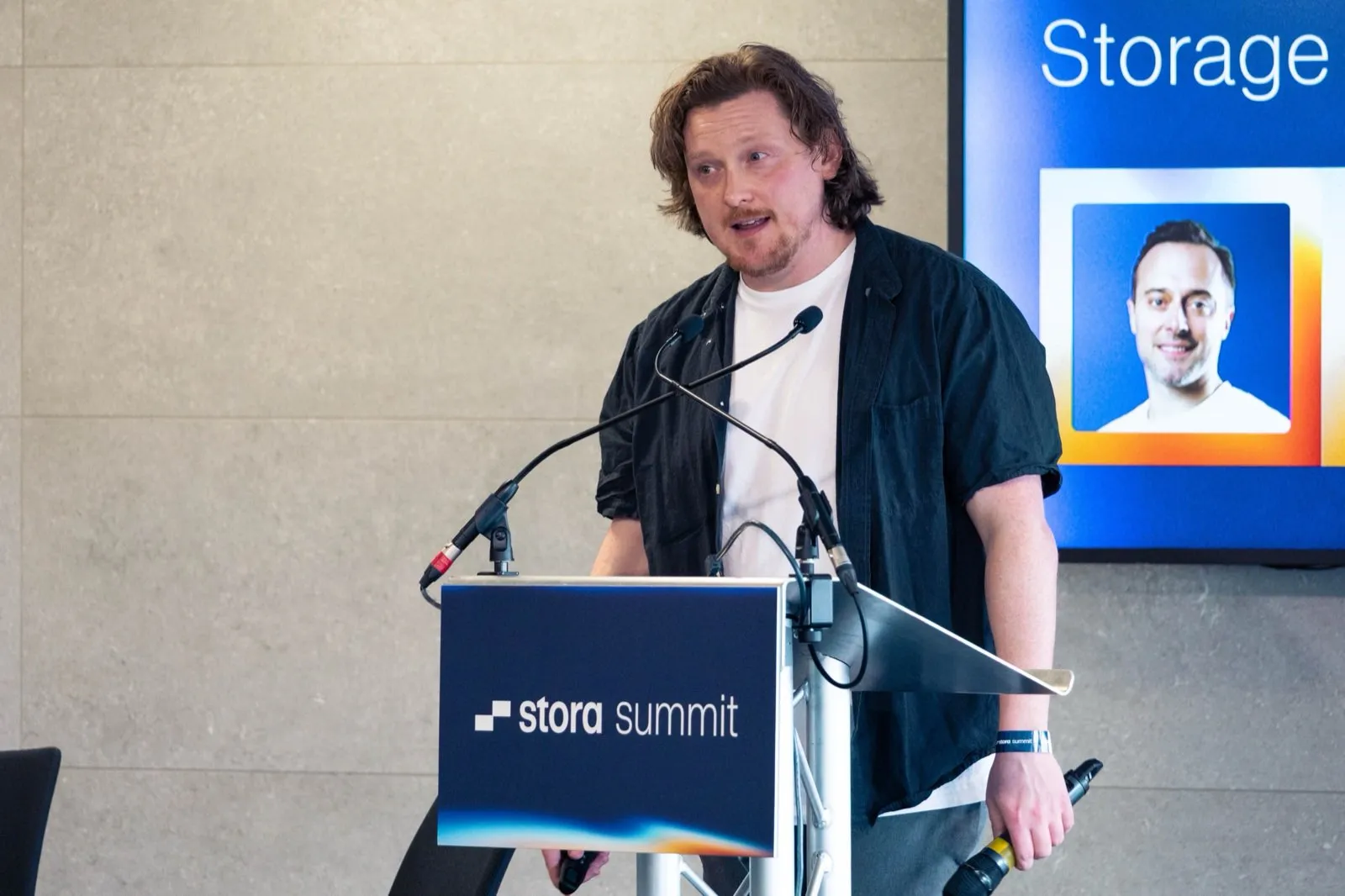
We're inviting three self storage operators on stage who've been actively letting AI voice agents speak directly to their customers on the phone. They're pushing the boundaries and reinventing an age-old process you all know well. To help us dig into the pros and cons of agentic customer service, we have Stora's own Head of Product and expert pain discoverer, David Hughes. But before we crack on with the panel, we have one of our panelists, Finn-Kristof Kausch from Space4You, who is going to run us through a quick case study on introducing AI agents. So please welcome Finn to the stage.
Finn-Kristof Kausch: All right, they're working. So good afternoon. Yeah, thank you very much. So afternoon sessions are always the hardest. Everyone is looking for the cold beer, but give me 10 minutes and I will show you some pretty cool stuff.
So my name is Finn. I'm in the self storage industry for almost 10 years now, and currently operate facilities in Germany and Switzerland. So when I opened my first site, everything was basically manual. So we had paper contracts, manual payments, and yeah, endless administration. So when I founded Space4You in 2022, I had one clear goal: build a self storage facility designed around automation from day one. So then I was very happy that I chose Stora for that journey back then. So with Stora, we automated almost the entire customer journey, but there was still one process that surprisingly is old-fashioned, and that's the telephone.
So today, I would like to show you how we finally solved that problem. But before we continue, let me check… here we go. Okay, so before we continue, I would like to ask a question. So who of you knows your average customer's lifetime value? Hands up. Want to say? 2000 euros. Another number? 1500. Another one? So average is around 1500 to 3000, yeah. It always depends on your unit mix, actually, per customer. So think about that number for a minute, because every single phone call that goes unanswered could be a customer you will never acquire. So a missed call isn't just a missed call. It's a potential 3000 euro who are walking straight to your competitor.
And here's what I actually find strange about our industry. We've spent millions building highly automated self storage facilities. Customers can book online. Payments are automated. Access control is automated. Security runs 24/7. Everything works around the clock, and yet the most important moment in the customer journey still depends on whether somebody is available to answer the phone or not. So let me be clear about something. I'm not standing here telling you to replace your sales team with AI. In fact, a great sales person still beats AI today. I hope that's still true for quite a while. This isn't about replacing people. It's about making sure every customer gets an answer. So think about it. You already paid for that phone call. You paid for Google ads. You paid for SEO. You paid for billboards. You paid for signage, and so on. All of that money was spent before the phone even rang, and then sometimes nobody answers. So when do calls actually get missed? Not because people don't care, because real life happens. So someone is showing a unit, for example. Someone is helping a customer. It's a Saturday. It's a public holiday. Other situation every single operator in this room knows: three calls at the same time, a walk-in customer without an appointment, and the postman at the door. At that point, somebody loses. So the call ends up probably in a voicemail or at the call center that never visited your facility, and most of the time don't have the live data from your system. Either way, the customer might be gone.
So we actually started looking for a better way, and we found a strong partner that solves exactly that problem. So that partner is fonio.ai. So we built together with [fonio.ai](http://fonio.ai) an AI assistant specialized for the self storage industry. What impressed us was that it could do three things extremely well. It answers every call 24/7, 365 days a year. It answers almost instantly in a natural human voice, and it can do that in more than 20 plus languages. So here's the thing: a voice agent that only talks isn't actually that interesting. The real breakthrough happened when Stora launched its public API, because now the AI doesn't just answer questions. It can actually do things. It can read. It can write. It can create. It can update, all directly in Stora. So this is the moment when AI becomes a real team member. So enough from me. Probably everyone wants to hear a demo, so I recorded a very quick demo two days ago, just to give you a feeling how it sounds.
AI Operator: Hello, this is Olivia from Space4You. Just a quick note, I am an AI assistant and this conversation is being recorded. How can I help you today?
Customer: Hi, Olivia. This is Ben speaking. I'm looking for some storage. Do you have something available?
AI Operator: Hello, Ben. To find the best storage option for you, may I ask the approximate size of your home, apartment, or office in square meters?
Customer: Sure, just the two bedroom apartment, and I think we have around 95 or 100 square meters of living space.
AI Operator: Thank you. For a 95 to 100 square meter apartment, about 10 to 15 square meters of storage space is usually suitable. I will check availability for storage units in that size range for you.
I found one suitable storage option for you. An 11 square meter storage unit on the second floor is available. This storage unit currently has a promotional discount. You would pay 112 euros for the first month, then 224 euros afterwards. Would you like me to send you the direct booking link for this storage unit by SMS?
Customer: Yes.
AI Operator: I will send the booking link to your phone number now. May I have your full name and email address to record your interest for our team?
Customer: Sure, my name is Ben Taylor and my email address is ben.taylor@junior.com.
AI Operator: Thank you, Ben. I have recorded your details and your interest in the storage unit. Is there anything else I can help you with today?
Customer: No, that's fine. Thank you.
AI Operator: Thank you for your call. Have a nice day.
Finn-Kristof Kausch: So, and here's what's happened before the call even ended. The customer hangs up, and within seconds, a new lead was being created directly into Stora: name, phone number, email address, and a note with a summary of all of that. A direct booking link has already been sent to the customer. So that means, by the way, it reduces your ad spend, because the customers don't have to click again on your expensive Google ads. Nobody of my team touched anything. The entire workflow happened completely automatically. So just very quickly about that, you just get the feel about the pricing. Earlier, I mentioned that a typical customer might be worth up to 3000 euro, so that solution doesn't need many wins to pay for itself.
But there is something we didn't expect. Some customers don't want to call us at all, especially the younger generation. They want to message. So the same assistant is now available also on WhatsApp. Same knowledge, same logic, same automation. You even can make a human handover, so you can take over the communication and give it back to the AI when you are done. The customer can send voice messages and, very shortly, also pictures, which is very handy if you are running an unmanned site. So the customers can actually send a picture of their empty unit, so you can rent it again much faster and can pay the deposit back.
So if you're still skeptical, it's perfectly fine. So call it yourself. We have put a live AI assistant on Gavin's own Stora site because he's so busy building great software. And yeah, I would encourage you to call it this weekend. Challenge it, ask difficult questions, and decide yourself. Just at the end, please say, that's just a test. Otherwise, this will be my last Summit when the team has to follow up 200 leads on Monday morning.
So we have spent 10 years automating self storage. The conversation was basically the last piece, and now we have automated that too. Thank you. Thank you very much. If you want to know more about that, here are my contact details, and that's it for me. Thank you.
Aled Bidder: So we'd like to kick off the panel now. David will come up and join us in a second, and I'd also like to introduce our other panelists. We have Roger Canham from Smart Box. Hi, Roger. And Tim Brant from Brant Self Storage as well, please. Thanks so much.
David Hughes: So let's introduce you guys then. I know we started with you, so we’ll start at the other end. Tim.
Tim Brant-Coles: Hello, hello. Hi, buddy. I'm Timothy Brant from Brant Self Storage and, yeah, here to talk about AI.
Roger Canham: Hi, Roger from Smart Box. We've been doing storage since the end of 2021. We've got five sites now. I'm still learning a lot.
David Hughes: Finn, feel free to reintroduce yourself.
Finn-Kristof Kausch: All right, okay, yeah, my name is Finn. I'm running different sites in Germany and Switzerland, and we also just started our third party management system, where we're also using that AI system for, and yeah, I'm looking forward to talk about AI.
David Hughes: So you're all experimenting with AI agents, and what's very interesting to us, and probably everyone in the room, is that you're all using different tools, which I find super interesting. I think it's a testament to where we're at in software. But in one line, I'm going to start with Tim again. Just explain to everybody, what does your AI agent do?
Tim Brant-Coles: So our AI agent is effectively GHL, driven by probably quite a few models, and it's there gathering data, talking to the customer, being there for when the customer needs it.
David Hughes: So any examples, Tim?
Tim Brant-Coles: Yeah, so somebody's on the phone. The phone rings and we can't pick it up. The AI agent is there and interacts with the customer.
David Hughes: Rog.
Roger Canham: We are you integrated with Stora. We're using a platform called Unity, which is an American product. We've been running that since January. It handles inbound voice, emails, live chat, and also our WhatsApp channels, and it goes from effectively first touch right through to sending out a booking link.
David Hughes: So I'm just going to drill into that, because you touched on the customer experience a bit there, Rog. And so, like, you run pretty much unmanned facilities, right? Unstaffed facilities, right? So the AI agent is effectively your front desk. Do you see it like that, or that's what it sounds like to me?
Roger Canham: Yeah, I think we run a pretty lean operation at five sites, and effectively one person in the office running it. So that's about as lean as you can get, I think, and we want to stay that way. That's really the way we've designed it, to be scalable, super lean. I think we didn't want to get caught in the gray area of a little bit of staffing and not full service. So our model is as lean as you can get. Our cost base reflects that, and obviously what we can then afford to charge customers. So we're not in that middle ground. It handles everything for us, and that's the model going forwards.
David Hughes: Interesting. We'll get on to pricing and stuff later. Interesting. So Tim, from knowing you from being a Stora customer, like, you build a lot of tools and you instrument everything, right? You build your own stuff. What was the moment that made you decide, I want to try this, I want to try an AI voice agent?
Tim Brant-Coles: Lots of people in the room will know him, Rennie Schafer, and one of his great ski workshops. And I was, I'm a very dyslexic person. If anybody's seen my text messages, you'll probably realize how bad I am. And I was at a talk where a guy was teaching us about ChatGPT, and I thought, here we go, another talk where it's nothing to do with storage. And I saw the light bulb. I went, oh my god, that's where things changed for me. You know, and that's where I really lent in, and I thought, do you know what? If you have the imagination, and a lot of us are very imaginative, we're entrepreneurs. Like, let's lean into this. Like, I'm not super techie, but I have the imagination, and the tech people don't have the imagination. That's where the real, the gap, you know, between me and another operator just widened, because I thought I need this. I'm going to go and build it.
David Hughes: Nice, cool. Finn, we saw what your voice agent does after a bit of tech mishaps. I don't know how to blame, but I blame the Wi-Fi. But how have your, like, how have your customers reacted based on what we saw? Like, what's the general customer reaction? Do they know it's AI, and do you think it matters?
Finn-Kristof Kausch: Well, first of all, they know it's AI because we say that it's AI, actually. And I think the expectation from the customer is, just, they want to have the problem solved or the question answered. And in self storage, probably 80 to 90 percent, we always have the same questions. So this is why I think that easily AI can take over 80 percent of the complete communication with the customers.
So for example, this was just an example from a lead. If an existing customer calls us, they will be greeted directly by their name, because with the API, we are having a look because of the telephone number, which customer it is. It can tell you about, you know, if they are late on the invoice, the AI can tell you how much it is, how much you have to pay, and when we get the problem solved directly, the customers are happy also to communicate with AI.
David Hughes: So, okay, so it sounds like you're relatively happy with how it's going. Do all three of you agree with that? Are you, is this like positive, like a net positive? Or is it, you know, what's, I'm talking about results. Is there any way we can go?
Tim Brant-Coles: Yeah, I think it's a net positive, and if you're not using it right now, then you're a bit stuffed.
David Hughes: So what's, like, this is a question for all three of you. Concretely, what's measurably better? What can you quantify that is better about this before then, this kind of future state?
Tim Brant-Coles: Consistency.
Roger Canham: Yeah, I would say, and actually at this point I want to thank my mum. I think we should all thank our mum. But when I looked to implement this, you hang your nose over shiny new things as they come out, and we all looked at chatbots and how automated they were. And actually, I don't think the customer experience is very good. So I kept looking for something I thought would do the job. And when the latest models came along, we had a virtual office, a virtual assistant out of hours. So you wouldn't get voicemail. You would always speak to somebody all week. They would just take a message.
So I then thought, okay, but I'll test drive Unity, test drove Swivel, which is another American provider, and tested our own system, and went to my mum, my sister, my kids, three or four friends, and just said, look, pretend you need storage. Call these numbers. Didn't tell them they were AI. Just call these numbers and see how you get on, but ask the same questions to each of these. And really, a bit of a beauty parade. Which ones would you trust with your storage?
And it's at that point that my mum, my sister, my mates, pretty much universally came back and said it was a bit robotic, but we trusted the answers we were getting, and they were precise, and they were to the point. Which for me then was, okay, we need to do this, and it was a when, not if, type answer.
David Hughes: See, I find that super interesting because it's not, it's not, you leaned us to phone something, you know, pre AI, and it would be like press one to do this, press three to do this. It's kind of the same paradigm for people. So I find that super interesting. Tim, what do you think?
Tim Brant-Coles: Yeah, I agree. I agree here, and I think you've got to try the models. And I think the problem is every model is trying to outdo the one before. I'm pretty sure by the time I finish this talk, there's another model out there that's probably better than your one and my one. So if you think you have got a good model, then you haven't. It's probably another one sat around the corner that's better, and I'm sitting here now thinking, maybe I should go back and just keep looking, because somebody will just pop up around the corner. I mean, that voice sounded better than my one from GHL, but I don't think it asked enough questions, and I think it was just a bit sharp and a bit to the point. That's not what the conversation the customers are gonna have. Sorry.
David Hughes: Are we having an AI off here?
Tim Brant-Coles: Like, yeah, sorry. I had two cups of coffee.
David Hughes: Oh, very, very interesting. So, I'm just conscious that not everybody in the room has probably experimented to the level that you guys have. Like, when you say try the new models, what does that mean practically for the people in the room?
Tim Brant-Coles: Typing voice models, and go through. They all have that link where you can just call them. But look, they are getting really better. You've just got to throw a curve ball. And when I was doing the one with, I actually did a really good experiment, and I put really loud music on, and I pretended I was in a nightclub, and I was saying, yeah, five pints of Stella, and all this. And I've wanted to throw it off course, and that's what you've got to do.
David Hughes: Sure you're pretending?
Tim Brant-Coles: Yeah, well, did have a drink on the side. But you've got to try and throw the models off, and that's the point. And, you know, as much as AI is built to be perfect, humans were not perfect. And the amount of times that I've listened to my calls back at home, and I've done thousands of calls, as I'm sure you have and you have, and I just go, oh god, why didn't it just do what it was told? And that's what's changing. It needs more input. It needs more calls. Every time we do an AI call, we're feeding a monster, and one monster is feeding into another monster, and it all goes back to the big monster.
David Hughes: So that's interesting. So in that context then, does that make switching more difficult when it comes to trying these new models? Or for people, or is it just, can you take your data with you if you're training these models on your business and all these conversations? Does that mean it's easy to just move them?
Roger Canham: Well, six months in, we don't know yet because we haven't moved. Certainly the transition across, these are not plug-and-play. You have to think hard about how you set them up, the amount of data you put in. We were fortunate in that we'd got all our live chat. We had emails from all of those conversations. We had transcripts from our voice, which then gave us a database we could then analyze and set up the initial knowledge bank that the AI would use. So do the work up front and then keep working. There isn't probably a week goes by where, and you've alluded to the same, where you're not looking at the calls and going, well, you know, could they resolve that more quickly, more effectively? Could they respond differently, more efficiently? But the beauty is that when you fix that, that's fixed forever. When you said Leicester, you can park your car overnight. Max knows next time somebody calls Leicester and says, can I park my car overnight? It says yes now. In a call center, it's hard to get those nuances for every site in the knowledge bank that your call agents can use. So the consistency you alluded to earlier is one of the lovely things about this, is you fix it once, and every time it's right.
David Hughes: So you're all scaling to some degree in different ways. For everybody here who's thinking of opening another site, where has agentic AI helped you with scaling, other than not having to hire someone to do parking?
Tim Brant-Coles: The AI agents, I think, like everybody who's in here, like maybe techie, maybe not, maybe super entrepreneurial, but you don't have to be smart anymore. You can just get somebody to do it for you. I'm not a smart person, but finding new sites, just build a tool, go and build something. It's so easy. Like, honestly, you could build something by tomorrow evening. You find somebody in a certain part of the world, or whoever, or just super techie person, and get them to build you something to go and find you sites. I mean, I could email every self storage operator probably within 20 minutes if I sent an email to somebody right now. Finding new sites, buying new sites, you know, there is just so much stuff out there, and that's how I would, you know, be leveraging AI right now.
Finn-Kristof Kausch: Then I think it's a great time where we are at the moment. You don't need to have a lot of funds. We don't need to have a team of 10 coders anymore. You just need to have an idea and to speak it, basically, to a ClaudeCode or whatever tool you're using, and sitting on a sofa on a Sunday evening and just build an app, or whatever you need at the moment. So it's a different time.
David Hughes: Rog?
Roger Canham: Yeah, yeah. I would say, using AI, the main bottleneck is probably me and my imagination, to be honest. Not gifted with your imagination, it seems to be, really. But really, get your feet wet. Just get stuck in. Don't be afraid. I am conservative, but nevertheless, the limit really is in how you think you can deploy, and you've probably heard today some ideas about things you could do, and the way you could perhaps look at AI and use it in small parts of your business. Use it carefully, thoughtfully. It'll augment what you do. It won't do what you do. It'll augment what you do, and that's, it won't give you the answer, but it can help you along the way.
David Hughes: How are we for time, Aled? Hurry for time? Finish, not okay. Okay. I was like, I don't see a clock anywhere.
So, okay, just to wrap up then. Starting out, like I always said, you know, go look at the models, you know, bring us some context. Is there any other advice you would give to people in the room about getting started with AI in general, or agents specifically? Where would you start, and give some advice to start?
Finn-Kristof Kausch: I would say it depends. So, there are different finished products on the market. So it depends if you want to spend the time, let's say six months, to get to the same level like different products at the moment, or you just get a finished product actually. But I always would recommend actually to do it yourself, because you can learn so many things. And by the way you're doing it, you're finding out that you can automate other things, but you haven't thought about it.
David Hughes: So yeah, it opens doors.
Roger Canham: Yeah, for me, it's a bit of a kid in a sweet shop moment, really, when I look at all of these shiny new things, things you can automate, different areas you can tackle in your business. Probably six months ago, conscious of how I like to experiment with stuff, I actually wrote myself, I wrote to myself, a charter of automation. These are my rules and guardrails about the things I will automate and why. And even today, there was a piece, Google reviews. We're automating how we collect reviews. We've written a paper about how we're going to do it. I've now compared it to my charter of six months ago. Am I sticking to the rules I set myself? Are the objectives of what we're doing consistent with improving customer service, being a more competitive offer? Just those simple things means that actually you won't arrive with a range of automations that actually don't talk to each other and aren't consistent with, really, those key goals.
Tim Brant-Coles: I think, go and do it, even if you think you're going to mess it up. I think go and plug it in, because I think even at its worst, it's going to be better than a phone ringing. The amount of times I've called operators when I'm trying to buy them, or go into an area and open a site, and the phone doesn't get picked up. I don't understand if we spend three million quid on a building and then we let a phone ring. That just blows my mind. So plug something in. Mess it up. But at least you know that it's going to capture the name, their email, and this is the basics, guys. This isn't the hard stuff. A name and an email is better than them calling my competitor three minutes after they put the phone down. So I think try it, mess it up, and move forward.
David Hughes: Thank you all very much. Do we have time for any questions, or what, we call it there? Or has anyone got any questions? Guess we do have time. No questions, really? We got one question. We'll take one question.
From the audience: How confident are you in the resilience of these tools you're using there? We'll see, built off multiple models, each has its own weak points, and being a critical system, how confident are you in that one part won't fall over?
Tim Brant-Coles: I've actually built a heartbeat test, which is effectively, giving away a major secret here, but it's a good one. Built a heartbeat test that tests all 20 of our locations, all our landing sites, all our telephone numbers, all our Texas, everything. And it effectively beats, I think every Laura from YBA help me build it, it beats every 30 minutes. So it gives me a readout, and this morning I got my readout saying everything's alive. So to answer your question, is to build another tool to check everything was working right.
David Hughes: Any more questions, or will we move on? Thank you all very much. Thanks. Nice one, everyone. Cheers.